Inventory Mgmt: How It Actually Works Day to Day
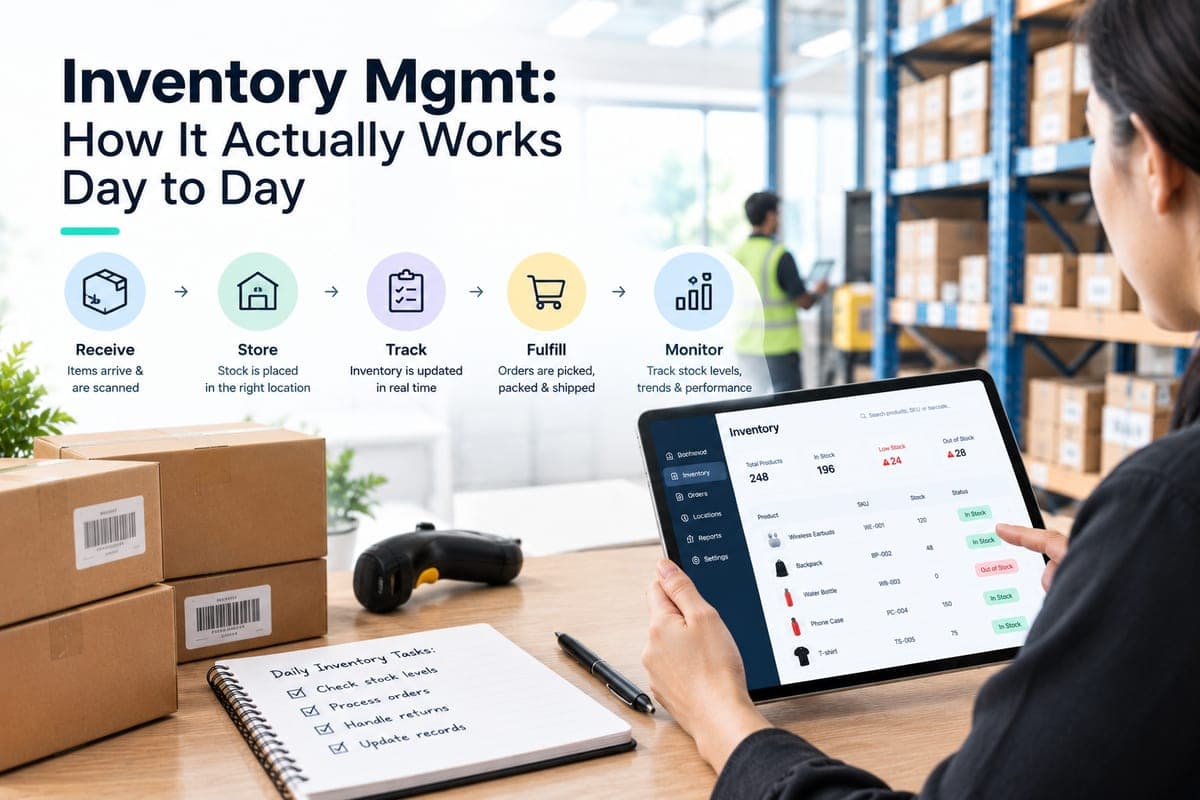
Inventory mgmt — shorthand for inventory management — is the ongoing work of forecasting demand, ordering stock, tracking it across locations, and fulfilling orders without tying up excess cash in goods that don't sell. The definition is simple; the day-to-day discipline of doing it well is where most businesses actually struggle.
This guide walks through how it works operationally: the workflow, who owns which part of it, the methods that structure decisions, and the mistakes that quietly cost the most money. For the definitional groundwork — types of inventory, management versus control — start with our guide to inventory and inventory management.
Table of Contents
- What "Inventory Mgmt" Means
- The Core Inventory Mgmt Workflow
- Who Owns Inventory Mgmt
- Inventory Mgmt Methods and When to Use Them
- Common Inventory Mgmt Mistakes
- How to Measure Inventory Mgmt Performance
- Inventory Mgmt Systems and Software
- How Nventory Fits Into Inventory Mgmt
- Useful Sources
- Frequently Asked Questions
What "Inventory Mgmt" Means
You'll see "mgmt" most often in job titles, internal dashboards, and shorthand notes. It's the same discipline as "inventory management," just written the way people actually talk about it at work.
It covers everything between "we need more stock" and "the customer received their order": forecasting, purchasing, receiving, storage, fulfillment, and reconciliation.
The Core Inventory Mgmt Workflow
Strip away the terminology and inventory mgmt is a repeating cycle with six steps:
- Forecast demand. Predict what will sell, by SKU, based on historical velocity, seasonality, and any known upcoming demand such as promotions or launches.
- Place purchase orders. Order enough to cover forecasted demand plus safety stock, timed against supplier lead time.
- Receive and inspect stock. Confirm what physically arrived matches the purchase order before it counts as available inventory.
- Store and track. Assign stock to a location — warehouse, bin, shelf — and keep the system's count in sync with physical reality.
- Fulfill orders. Pick, pack, and ship against incoming demand, decrementing available stock as it goes.
- Reconcile and review. Compare system counts to physical counts on a regular cadence, and feed actual sell-through data back into the next forecast.
The loop matters more than any individual step. Most inventory mgmt problems trace back to a break at step 1 (a bad forecast) or step 4 (stock tracking that doesn't reflect reality), because errors at those two points propagate silently through every step that follows. A forecast that's 20% high doesn't announce itself — it shows up months later as dead stock, by which time the money is already spent.
Step 6 is the one most often skipped, and skipping it is what turns a single bad forecast into a permanent bias: without feeding actual sell-through back in, next quarter's forecast repeats the same error.
Who Owns Inventory Mgmt
In practice, inventory mgmt is rarely one person's job. It's split across a few roles that need to stay coordinated:
- Inventory planner or analyst — owns forecasting and reorder point calculations, and is usually the first to spot a slow-moving SKU or a demand spike coming.
- Buyer or purchasing manager — owns supplier relationships, purchase order timing, and negotiating lead times and pricing.
- Warehouse manager — owns physical accuracy: receiving, putaway, picking, and cycle counts.
- Operations manager — owns the overall system, resolving conflicts between the above. A typical one: the planner wants tighter reorder points, but the warehouse can't absorb more frequent, smaller shipments.
In smaller businesses, one person often wears two or three of these hats — which is exactly when things break down first, because there's no natural check between the forecast and physical reality. The planner who builds the forecast is also the person counting the shelf, so a mistaken assumption never meets anyone positioned to catch it. If you can only separate one pair of duties, separate forecasting from cycle counting.
Inventory Mgmt Methods and When to Use Them
A handful of established methods structure most day-to-day decisions:
- FIFO (First In, First Out) — oldest stock sells first. Standard for anything perishable or with a shelf life, and the default for most general retail and ecommerce.
- LIFO (Last In, First Out) — newest stock sells first. Mostly an accounting and tax convention in specific jurisdictions, rarely used as an actual fulfillment sequence.
- JIT (Just-in-Time) — stock arrives right before it's needed, minimising holding cost. Works only with highly reliable, low-variability suppliers; a single late shipment cascades straight into a stockout.
- EOQ (Economic Order Quantity) — a formula for the order size that minimises combined ordering and holding costs. Most useful for stable-demand SKUs with predictable reorder cycles.
- ABC analysis — segmenting SKUs by value and velocity, where A is high priority and C is the long tail, so reorder attention scales with what actually matters.
Of these, ABC analysis is the one that most directly changes daily behaviour: it tells a planner which SKUs deserve weekly attention and which can be checked quarterly. Most functioning operations combine two or three rather than picking one — ABC to prioritise attention, FIFO for fulfillment sequencing, and EOQ or JIT logic layered on depending on how predictable each SKU's demand is.
Common Inventory Mgmt Mistakes
These show up repeatedly across businesses of every size, and most are structural rather than one-off errors:
- Forecasting on gut feel instead of data. Ordering errors and weak demand forecasting are among the leading documented causes of retail out-of-stocks, ahead of supply chain disruption. Most stockouts trace back to a decision made before the stock was ever needed.
- Treating inventory as a set-and-forget asset. SKUs that stop moving don't send a notification. They just sit, quietly accumulating carrying costs commonly cited at 20 to 30% of their value per year, until someone notices during a stock count.
- Reconciling manually and infrequently. Manual reconciliation is inherently reactive: problems get discovered after they've already cost money, not before.
- Managing channels as separate inventory pools. A business selling on multiple channels without unified visibility is effectively running several disconnected inventory systems that will inevitably disagree with each other.
- No clear reorder point logic. Reordering because stock "looks low" rather than against a calculated threshold — safety stock plus expected demand during lead time — produces both stockouts and, just as often, panic-ordering that creates overstock.
Fixing these rarely requires new tools first. It usually requires making the existing process less reactive: calculated reorder points instead of gut checks, scheduled reconciliation instead of annual fire drills, and one unified view of stock instead of a channel-by-channel patchwork.
How to Measure Inventory Mgmt Performance
A working process should be judged on a small set of metrics tracked together, not any single number in isolation:
| Metric | What It Tells You |
|---|---|
| Inventory turnover ratio | How many times stock sells and is replaced per period — see the full formula and industry benchmarks |
| Days Inventory Outstanding (DIO) | Average days stock sits before selling |
| Stockout rate | Percentage of demand that couldn't be met due to unavailable stock |
| Fill rate | Percentage of order lines fulfilled complete and on time |
| Carrying cost % | Total cost of holding inventory, as a percentage of its value |
| Order accuracy | Percentage of orders fulfilled without picking or shipping errors |
The reason to track these together rather than picking a favourite: a strong turnover ratio can mask a high stockout rate on your best sellers, and a low carrying cost can mask poor fill rates caused by understocking. None of these numbers tells the full story alone.
Inventory Mgmt Systems and Software
Below a certain scale, spreadsheets handle inventory mgmt adequately — but that ceiling is lower than most people expect, usually somewhere around a single location with a modest, stable SKU count.
Past that, dedicated software becomes less about convenience and more about accuracy: real-time stock counts, automated reorder alerts, and multi-channel sync are the difference between a proactive process and a reactive one. For the full breakdown of what inventory management software does — core functions, buying criteria, and related terminology — see our inventory management software glossary entry. For businesses running complex floor operations across one or more large facilities specifically, a dedicated warehouse management system covers a layer that general inventory software doesn't.
How Nventory Fits Into Inventory Mgmt
Nventory is built around the workflow described above, specifically for businesses managing inventory across multiple channels and fulfillment locations rather than a single warehouse floor:
- Real-time inventory sync in under 5 seconds across 40+ integrations spanning 23 commerce channels — closing the gap between what the system shows and what's physically true, which is where most of the mistakes above originate
- Multi-warehouse support with automatic order routing, giving the unified cross-channel visibility that manual, per-channel tracking can't. Location limits scale by plan, with unlimited locations on the top tier.
- 99.9%+ inventory accuracy, so the metrics in the table above are trustworthy inputs to decisions rather than confident-looking guesses
- A free plan, so you can see it running against your own catalog before committing to anything
Useful Sources
- A Comprehensive Guide to Retail Out-of-Stock Reduction — industry research on the root causes of out-of-stocks, including ordering and forecasting error
- Association for Supply Chain Management (ASCM) — the standards body behind APICS terminology and certification for methods like EOQ, JIT, and ABC analysis
- Warehousing Education and Research Council (WERC) — annual operator surveys and benchmarking data for fill rate, order accuracy, and related metrics
Closing
Inventory mgmt fails less often because of missing knowledge and more often because the day-to-day process is reactive instead of proactive — stock counts that lag reality, reorder decisions made on instinct, channels tracked separately instead of as one picture. Closing that gap starts with the loop in the workflow section above actually completing, every cycle, on data you can trust.
Frequently Asked Questions
It is a repeating cycle: forecasting demand, placing purchase orders, receiving and inspecting stock, storing and tracking it, fulfilling orders, then reconciling system counts against physical reality and feeding that data back into the next forecast. Most problems trace back to a break in that loop, usually at the forecasting step or the stock-tracking step, because errors there propagate through everything downstream.
It is usually split across an inventory planner who owns forecasting and reorder points, a buyer or purchasing manager who owns supplier relationships and order timing, and a warehouse manager who owns physical accuracy, all coordinated by an operations manager. Smaller businesses often combine these roles, which is a common point of failure since there is no natural check between the forecast and physical reality.
Forecasting on gut feel rather than historical data and calculated reorder points. Ordering and demand-forecasting decisions are a leading source of stockouts, which means many inventory failures start with a decision made before the stock was ever needed rather than with a supply chain surprise.
Track turnover ratio, days inventory outstanding, stockout rate, fill rate, carrying cost, and order accuracy together, not any single metric alone. A strong number in one area can hide a real problem in another: a healthy turnover ratio can mask a high stockout rate on your best sellers, and a low carrying cost can mask poor fill rates caused by understocking.
Spreadsheets can work at a single location with a modest, stable SKU count. Beyond that, or across more than one sales channel, manual tracking becomes a source of errors rather than a time-saver, since it cannot provide real-time visibility or automated reorder alerts. The practical threshold is lower than most people expect.
Related Articles
View all
Inventory Control: Methods, Systems & Best Practices
What inventory control is, how it differs from inventory management, perpetual vs periodic systems, and the methods that keep stock counts accurate.
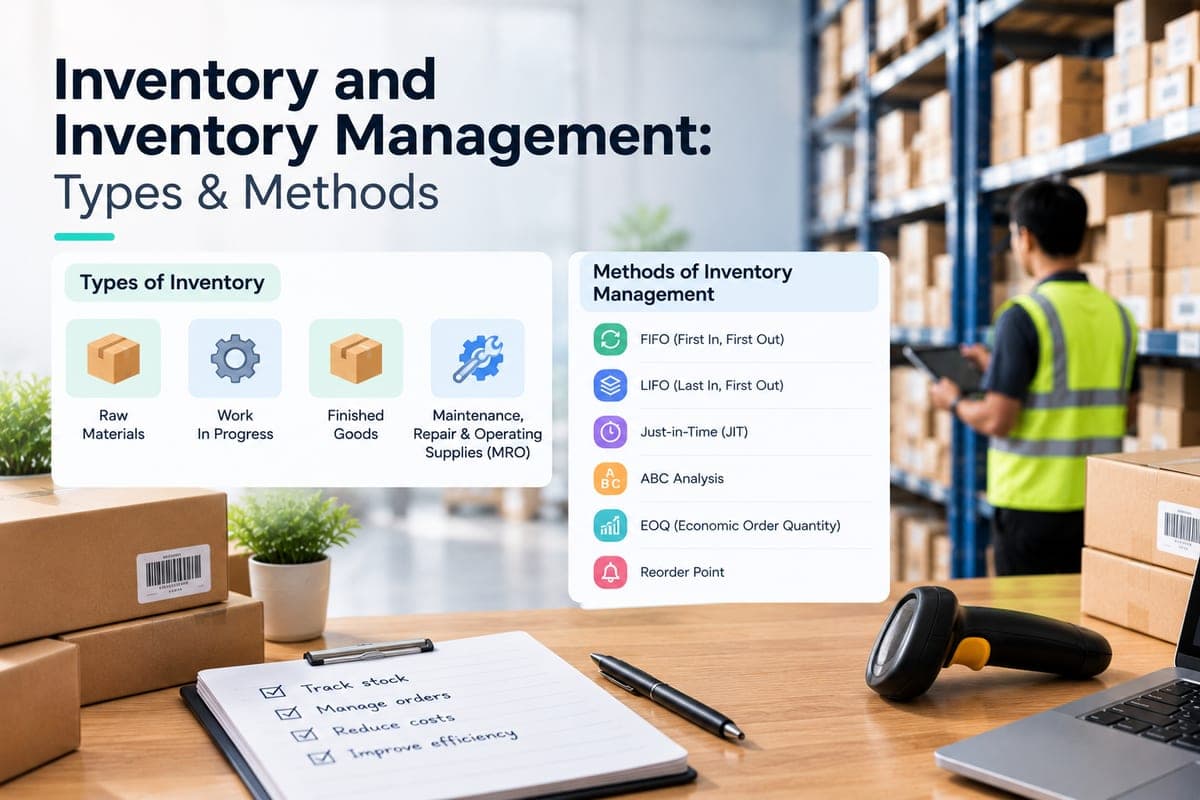
Inventory and Inventory Management: Types & Methods
The types of inventory, what inventory management involves, the methods that handle most decisions, and the metrics that show whether it is working.