Inventory Control: Methods, Systems & Best Practices
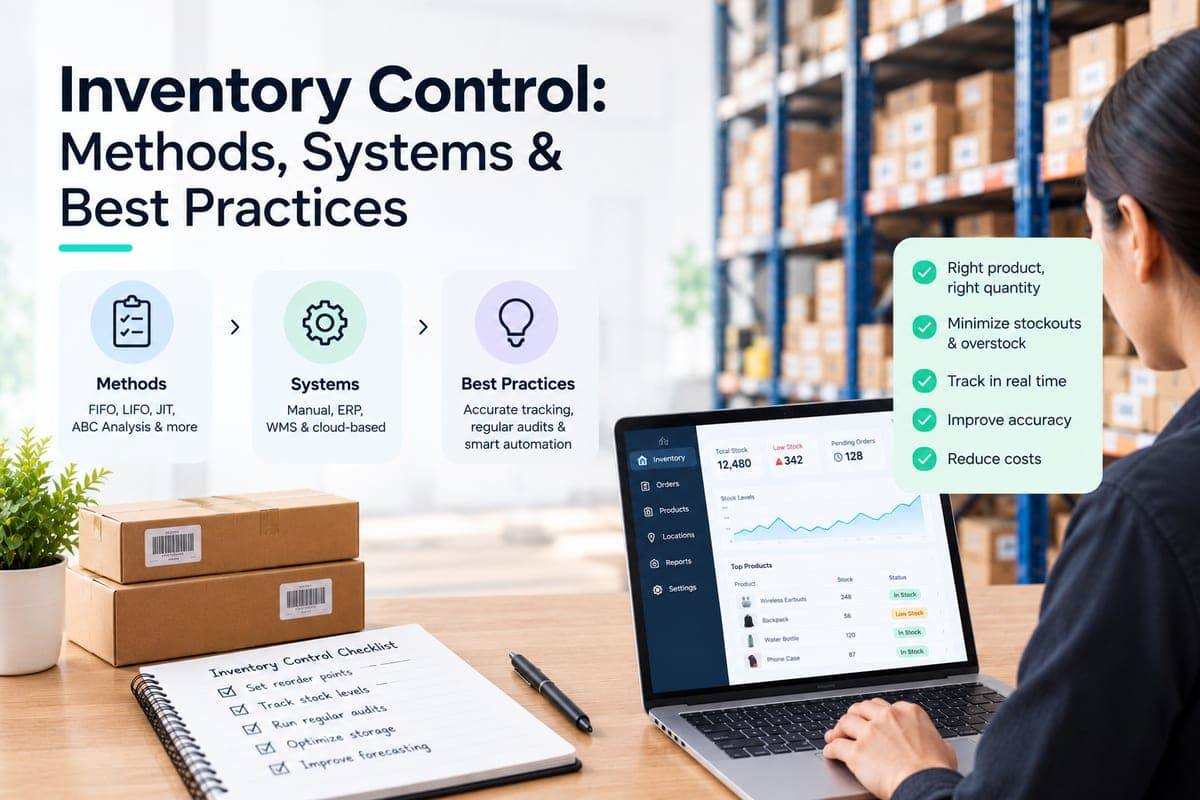
Inventory control is the process of managing and verifying the stock a business already holds — tracking quantities, auditing accuracy, and making sure physical counts match system records.
Where inventory management asks "how much should we have and where," inventory control asks a narrower question: "is what we think we have actually what we have?" It's the accuracy layer everything else depends on.
Table of Contents
- What Is Inventory Control?
- Inventory Control vs. Inventory Management
- Perpetual vs. Periodic Inventory Control Systems
- Inventory Control Methods and Techniques
- Why Inventory Control Matters
- Inventory Control Best Practices
- How Nventory Supports Inventory Control
- Useful Sources
- Frequently Asked Questions
What Is Inventory Control?
At its core, inventory control covers the day-to-day work of maintaining accurate stock records: receiving and logging incoming goods, tracking quantities as they move, auditing counts against system records, and correcting discrepancies before they compound.
It doesn't decide how much to buy or when — that's forecasting and purchasing. It makes sure the numbers those decisions are based on are actually true. For the practices side of this at scale, our guide to inventory control as an operations discipline covers how teams build and sustain the routine.
Inventory Control vs. Inventory Management
These two get used interchangeably, and the distinction is worth being precise about:
| Inventory Control | Inventory Management | |
|---|---|---|
| Question it answers | "Is our stock count accurate right now?" | "How much stock do we need, and where?" |
| Nature of the work | Tactical — auditing, counting, reconciling | Strategic — forecasting, purchasing, allocation |
| Time horizon | Continuous, day-to-day | Forward-looking, planning-oriented |
| Typical owner | Warehouse or inventory clerk | Planner, buyer, or ops manager |
Inventory control is a subset of inventory management, not a separate discipline. You can't manage inventory well without controlling it accurately first, but accurate control alone doesn't guarantee good purchasing or forecasting decisions built on top of it. Our guide to inventory and inventory management covers the strategic layer above this one.
If you're weighing this against a warehouse management versus inventory management question specifically — a related but different split, focused on physical space versus whole-business scope — see our separate breakdown of that distinction.
Perpetual vs. Periodic Inventory Control Systems
There are two fundamental approaches to how inventory control actually gets done:
- Perpetual inventory control — stock counts update continuously, in real time, with every transaction: sale, receipt, transfer, adjustment. This is the standard for any business selling through software-connected channels, since the system always reflects the latest known state.
- Periodic inventory control — stock is counted at scheduled intervals — monthly, quarterly, annually — rather than tracked continuously between counts. Cheaper to run with minimal tooling, but the business operates on stale data between counts, with no visibility into what happened in between.
Most modern operations default to perpetual tracking for the primary stock count, supplemented by periodic physical counts or ongoing cycle counts as a verification layer — not a replacement for it. The distinction matters most at the moment something goes wrong: with perpetual tracking you can see when a discrepancy appeared, because every movement is timestamped. With periodic counting, all you know is that the number was right in March and wrong in June.
Inventory Control Methods and Techniques
A handful of established techniques do most of the actual work:
- Cycle counting — counting a subset of SKUs on a rotating schedule instead of shutting down for a full physical count. The three common methods are ABC counting (prioritising high-value or high-velocity items for more frequent counts), random sample counting (selecting items at random on a regular schedule), and control group counting (repeatedly counting a small, fixed set of items to catch errors in the counting process itself, not just in the inventory). ABC counting is generally the most effective for ecommerce, since it concentrates effort where accuracy matters most.
- ABC analysis — classifying inventory into three tiers by value or velocity, where A is top priority and C is the long tail, so control effort scales with what actually matters. A-tier items typically get counted monthly, B-tier quarterly, C-tier once or twice a year.
- Barcode and RFID scanning — replacing manual data entry with scan-based logging at receiving, picking, and shipping. This is the single biggest lever for reducing the human-error component of inventory control; our barcode system guide covers implementation.
- FIFO, LIFO and FEFO — sequencing rules for which stock moves first, affecting both fulfillment accuracy and inventory valuation. FEFO (First Expired, First Out) matters specifically where shelf life, not arrival date, determines sale order.
- Safety stock and reorder points — technically inventory management decisions, but they depend entirely on control data being accurate. A reorder point calculated from a wrong stock count triggers the wrong order.
The target most well-run operations aim for is an inventory accuracy rate of 97% or higher, with mature cycle-counting programmes pushing past 98% — measured as the percentage of recorded quantities that match actual physical stock. Benchmark against your own starting point rather than a headline figure; the useful question is whether accuracy is trending up.
Why Inventory Control Matters
Poor inventory control doesn't announce itself. It shows up as symptoms that look like other problems: overselling that seems random, purchasing decisions that turn out wrong, and stock counts that quietly drift further from reality every week nobody checks.
Cycle counting programmes exist specifically because inventory record errors compound. An uncorrected discrepancy affects every purchasing, forecasting, and fulfillment decision made from that point forward, not just the one transaction that caused it.
The direct costs of poor inventory control are the same ones that show up in inventory management generally — stockouts, overstock, and shrinkage. But inventory control specifically is what catches shrinkage from theft, damage, or misplacement early enough to matter, since location-level tracking and regular counts surface discrepancies within days rather than at the next annual audit.
Inventory Control Best Practices
- Count continuously, not just annually. Rolling cycle counts catch errors while they're still small and easy to trace back to a cause.
- Prioritise by value and velocity. Not every SKU deserves the same counting frequency — ABC analysis exists precisely to focus effort where errors are most expensive.
- Correct discrepancies immediately, not in a batch. An error left uncorrected keeps distorting every decision made against that SKU until someone fixes it.
- Scan, don't type. Manual data entry is the single largest source of inventory control errors; barcode or RFID scanning at every touchpoint removes most of it.
- Track shrinkage as its own metric. A rising shrinkage rate is often the first visible signal of a control breakdown, well before it shows up in financial reporting.
- Treat every sales channel as part of the same count. For multichannel sellers, inventory control that only accounts for one channel's activity is auditing an incomplete picture.
How Nventory Supports Inventory Control
Nventory addresses the specific failure mode that breaks inventory control for multichannel sellers: stock moving across channels faster than a manual or single-channel system can track accurately.
- Real-time inventory sync in under 5 seconds across 40+ integrations spanning 23 commerce channels, so the recorded count reflects what actually happened rather than a delayed snapshot
- 99.9%+ inventory accuracy, which is the outcome inventory control exists to produce
- Unified visibility across your warehouses, so control isn't fragmented into separate, disagreeing counts per location or channel
- A free plan, so you can check real sync accuracy against your own catalog before committing to anything
Where Nventory doesn't replace dedicated inventory control practice: physical cycle counting, barcode scanning discipline, and shrinkage investigation are still operational work your team does. Nventory's job is making sure the system those counts get reconciled against is trustworthy in the first place.
Useful Sources
- Wikipedia — Inventory control — general reference on scope, shrinkage, and related terminology
- Association for Supply Chain Management (ASCM) — the standards body behind APICS terminology for cycle counting, ABC classification, and inventory accuracy
- Warehousing Education and Research Council (WERC) — annual operator surveys with inventory accuracy benchmarks drawn from real distribution centres
Closing
Inventory control is unglamorous, easy to underinvest in, and exactly the kind of problem that doesn't show up until it's expensive — a stockout, an oversold order, a shrinkage number nobody can explain. Keeping the underlying data accurate in real time across every channel and warehouse is what makes the counts your cycle-counting programme reconciles against trustworthy from the start.
Frequently Asked Questions
Inventory control is the process of managing and verifying stock a business already holds: tracking quantities, auditing accuracy, and reconciling physical counts against system records. It is the accuracy layer that purchasing and forecasting decisions depend on, and it does not itself decide how much to buy or when.
Inventory control is tactical: auditing and maintaining accurate stock counts, day to day. Inventory management is strategic: deciding how much to buy, when, and where to hold it. Control is a subset of management. You need accurate control data before strategic decisions can be trusted, but accurate counts alone do not guarantee good purchasing or forecasting built on top of them.
Cycle counting in its three common forms (ABC counting, random sample counting, and control group counting), ABC analysis for prioritising where counting effort goes, barcode and RFID scanning to remove manual entry errors, and FIFO, LIFO or FEFO sequencing rules are the core techniques most inventory control programmes rely on.
Perpetual systems update stock counts continuously with every transaction: sale, receipt, transfer, or adjustment. Periodic systems count at scheduled intervals instead, which leaves the business operating on stale data between counts with no visibility into what happened in between. Most modern operations use perpetual tracking as the primary system, with periodic or rolling cycle counts as a verification layer rather than a replacement.
Poor inventory control causes overselling, bad purchasing decisions, and undetected shrinkage. Because every decision built on inaccurate stock data compounds the error, a small discrepancy left uncorrected affects every purchasing, forecasting, and fulfillment decision made from that point forward, not just the transaction that caused it.
An inventory control specialist audits stock accuracy, performs cycle counts, investigates discrepancies, and maintains the processes that keep recorded inventory matching physical reality, including scanning discipline, reconciliation cadence, and shrinkage tracking.
Related Articles
View all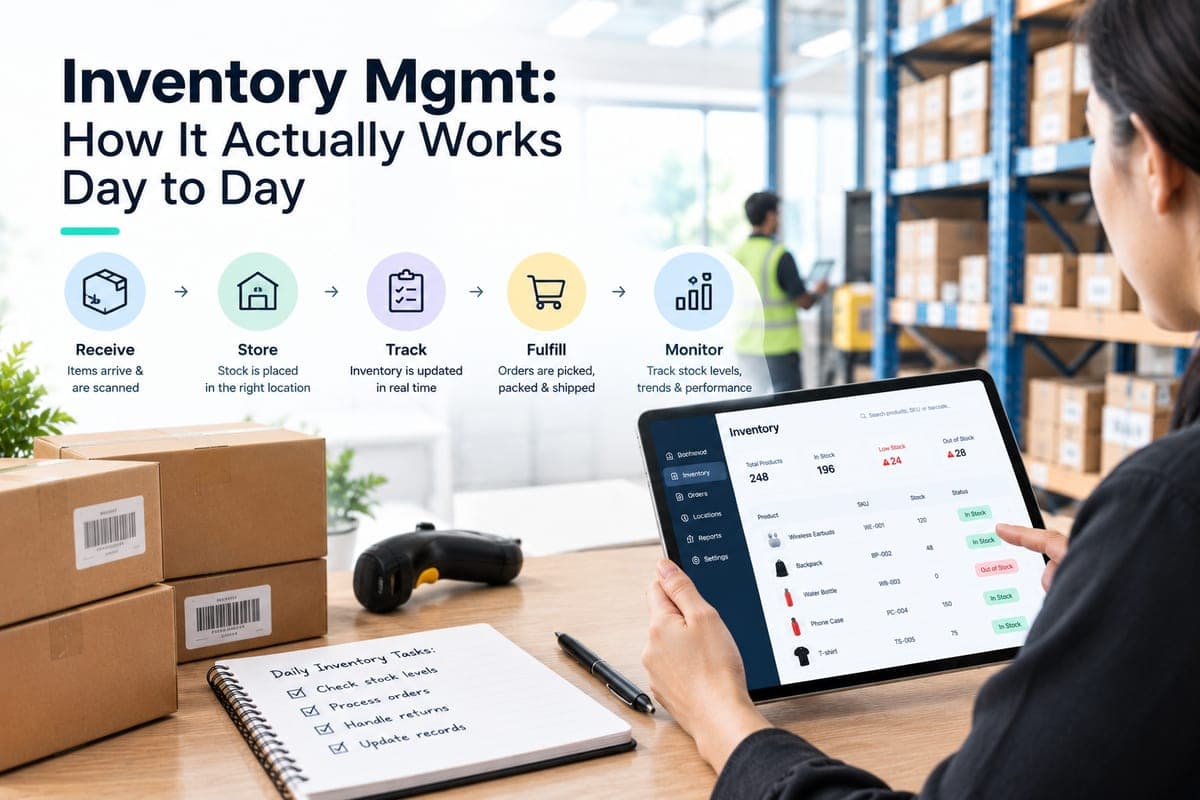
Inventory Mgmt: How It Actually Works Day to Day
The six-step inventory mgmt cycle, which role owns each part of it, the mistakes that quietly cost the most, and how to tell whether the process is working.
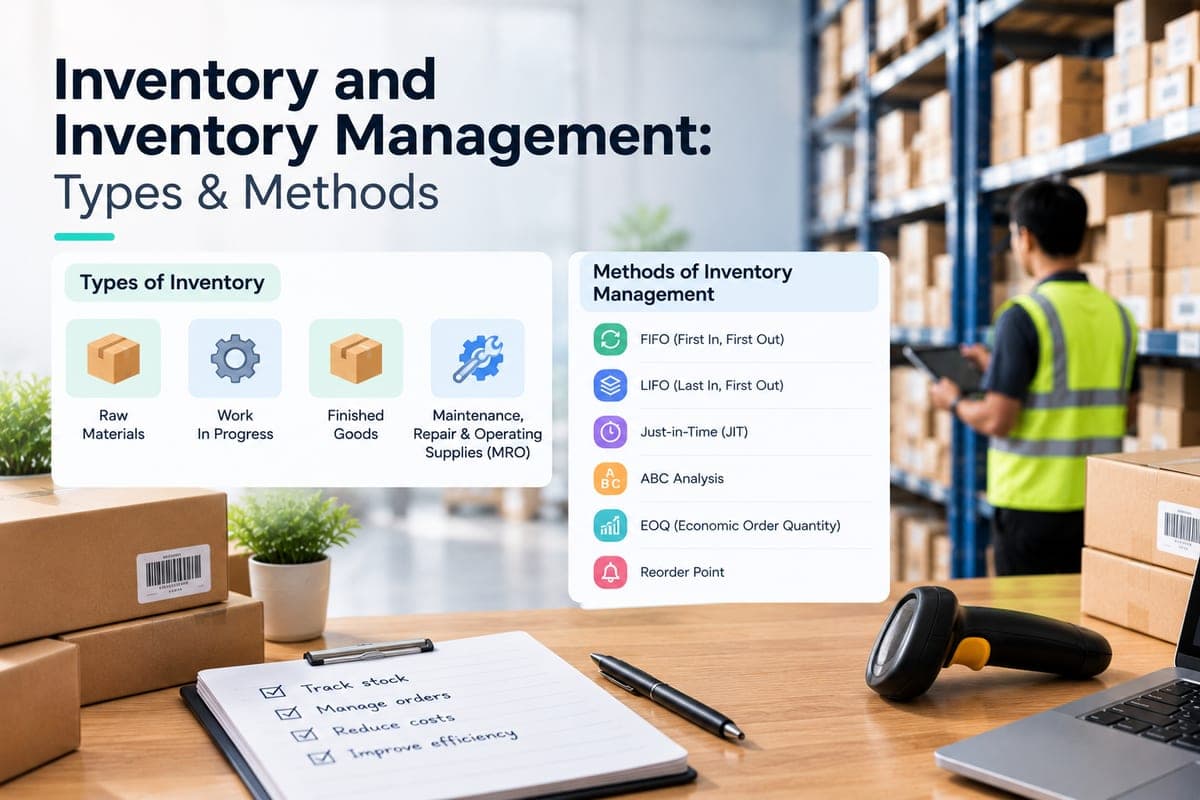
Inventory and Inventory Management: Types & Methods
The types of inventory, what inventory management involves, the methods that handle most decisions, and the metrics that show whether it is working.