Inventory Control: Operations Discipline for Scale
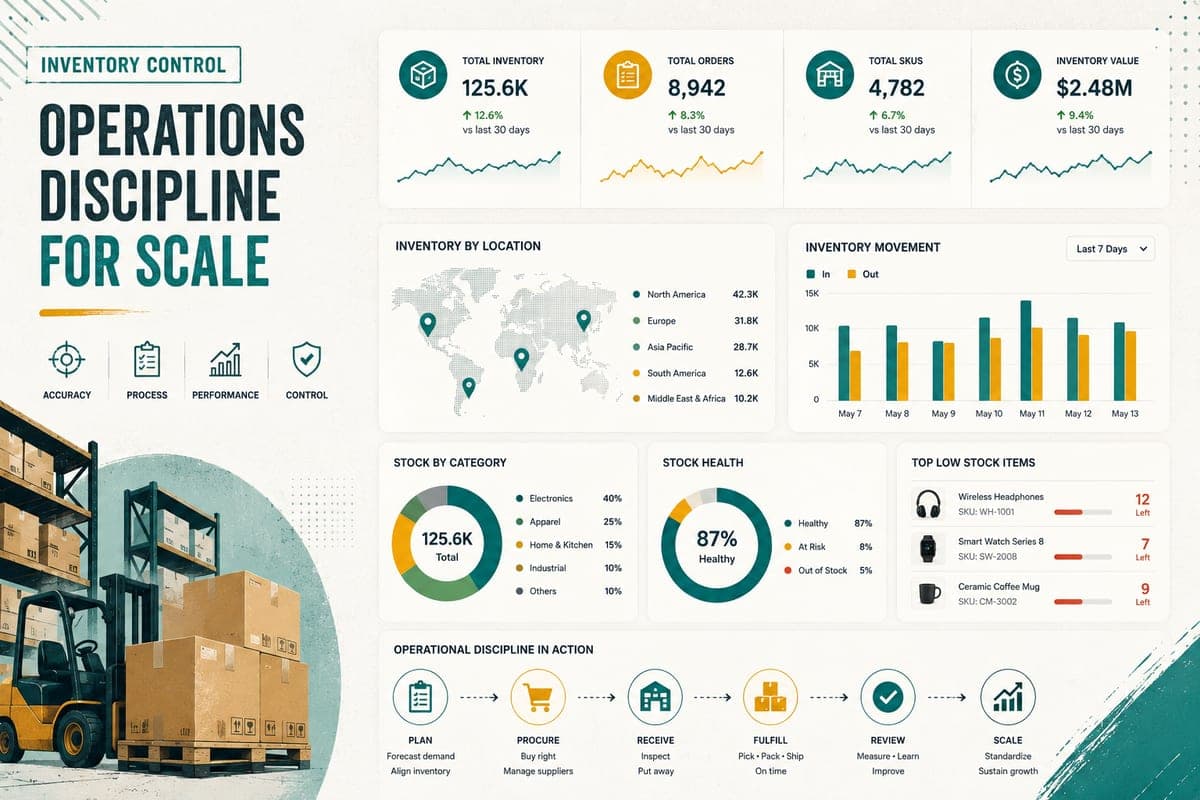
Inventory control is often confused with inventory tracking, but they are different disciplines. Inventory tracking is the technical layer, software showing current counts and history. Inventory control is the operational layer, the policies, procedures, and practices that determine how inventory data stays accurate over time. A store can have excellent inventory tracking software and still have terrible inventory control if the operational practices that surround the software produce drift faster than the software corrects it.
This article walks through what inventory control actually means as an operational discipline, the practices that separate clean operations from chaos, and how scaling brands implement inventory control to prevent the structural problems that consume team attention in less-disciplined operations.
What Inventory Control Actually Covers
The discipline of inventory control covers several specific operational areas that often get conflated.
Receiving discipline. How incoming inventory gets counted, recorded, and entered into systems. The starting point for accuracy, if receiving data is wrong, everything downstream is wrong.
Cycle counting procedures. Regular partial physical counts that catch drift between full inventory counts. The operational practice that prevents small problems from compounding into large ones.
Variance investigation. When physical counts do not match system counts, the process for investigating why and correcting both the data and the underlying cause.
Stock movement authorization. Who can adjust stock counts, transfer inventory between locations, or override system data. Without authorization controls, well-intentioned operators create drift trying to "fix glitches."
Damaged and reserved inventory handling. How non-sellable stock gets categorized, removed from available counts, and disposed of correctly. Common drift source when handled informally.
Returns processing rigor. How returned items get inspected, restocked, or removed from inventory. Strong returns processes prevent the most common inventory control failure mode.
The technical inventory tracking software provides visibility into these areas. The operational inventory control practices determine whether the visibility translates into actual accuracy. For the technical side, see stock management.
Why Inventory Control Discipline Matters More Than Software Choice
Operations frequently invest heavily in inventory tracking software and skip the operational discipline that makes the software effective. The result is expensive tooling that produces marginal improvements because the underlying operational practices keep producing drift the software has to fight against.
The relationship works the other way. Operations with strong inventory control discipline can produce excellent accuracy on relatively basic tools. Operations with weak discipline produce poor accuracy even on sophisticated platforms. The discipline matters more than the software.
This is not an argument against good software. Good tools amplify good discipline. But the discipline has to exist first, or the software just makes the chaos faster.
According to Wikipedia's overview of inventory management, operational accuracy depends on both the data infrastructure and the practices that maintain data quality over time. Inventory control is the practices component; without it, infrastructure cannot compensate.
The Five Inventory Control Practices That Scale
Across scaling ecommerce operations, five inventory control practices consistently separate well-run operations from chaotic ones.
Practice 1: Standardized Receiving
Every inbound shipment gets counted by a specific person using a specific procedure with specific tools. The procedure includes verification against purchase orders, damage inspection, and entry into systems within a defined timeframe.
Operations without standardized receiving have receiving accuracy that varies by person, day, and shipment volume. Operations with standardization have predictable, auditable receiving data.
Practice 2: Weekly Cycle Counting
A subset of SKUs gets physically counted each week with results compared to system counts. The cycle covers the full catalog every 12 weeks (quarterly) or 4 weeks (monthly) depending on operational risk tolerance.
Operations without cycle counting catch drift only at full annual inventory counts. By then, the drift has compounded for months. Operations with weekly cycle counting catch drift within days.
Practice 3: Documented Variance Investigation
Every variance between physical and system counts triggers a specific investigation procedure. The investigation identifies the cause (receiving error, damaged goods not removed, refund-restoration failure, etc.) and updates both the data and any underlying process problem.
Without variance investigation, the cause of drift remains unknown and the drift repeats. With investigation, structural causes get addressed and drift stops recurring.
Practice 4: Authorization Controls on Stock Adjustments
Manual stock adjustments require specific authorization. Junior team members can flag issues but cannot directly adjust counts. Adjustments get logged with the reason and the authorizing person.
Without authorization controls, well-intentioned team members create drift by "fixing" what they perceive as system glitches. With controls, the systematic causes get identified and addressed instead.
Practice 5: Returns Processing Standards
Returns get inspected against specific standards (damage assessment, restocking eligibility), processed within defined timeframes, and either restocked correctly or removed from inventory with proper disposition.
Without returns standards, returns become a major drift source. Items get restocked that should not, items get removed without proper accounting, and refund-restoration mismatches accumulate. For the broader operational context, see inventory tracking.
How Software Supports Inventory Control Practices
Strong inventory control practices need software support to scale. Specifically, software should provide:
Authorization frameworks. Different permission levels for different stock operations. Junior staff can flag issues; senior staff can authorize adjustments; admins can configure procedures.
Audit trails for every change. Every stock movement logs who made it, when, why, and what the count was before and after. Variance investigation depends on this data.
Cycle counting tools. Software that generates cycle count lists, accepts physical count data, calculates variance, and flags items requiring investigation.
Returns workflow integration. Refund processing that automatically triggers stock restoration where appropriate, flags items for inspection, and routes non-restockable items to disposal processes.
Reporting that supports practices. Variance trends over time, receiving accuracy by person, returns disposition patterns, authorization log review. Reports that enable management oversight of the operational discipline.
Software without these features can be made to work with strong practices, but it is harder. Software with these features amplifies practices that already exist.
The Connection Between Inventory Control and Multi-Channel Operations
Multi-channel operations have more inventory control challenges than single-channel operations because more events create drift opportunities.
More channels = more sync events that can fail. Each connected channel produces inventory events. More channels mean more potential failure points.
Variation handling across channels. Variations that map cleanly within one channel may map differently across channels. Cross-channel variation tracking adds complexity.
Channel-specific returns workflows. Amazon, eBay, and other marketplaces have different returns processing rules. Operations need to handle each channel's specific patterns correctly.
Buffer stock coordination. Cross-channel selling makes buffer stock more important and more complex. Buffers need to coordinate across channels rather than work independently.
For multichannel ecommerce operations specifically, inventory control discipline becomes existentially important rather than just operationally helpful. The cost of weak inventory control compounds across channel count.
How Nventory Supports Inventory Control Operations
Nventory.io provides the software foundation that strong inventory control practices need. The platform implements authorization frameworks, comprehensive audit trails, returns workflow integration, and reporting that supports operational discipline.
According to Cloudflare's documentation on webhooks, event-driven architectures naturally produce the granular audit trails that variance investigation depends on. Nventory's webhook-driven architecture means every stock change generates a comprehensive log entry that operators can review.
For WordPress and WooCommerce stores, download Nventory free from WordPress.org. For Shopify operations, install Nventory from the Shopify App Store. Both versions provide the same audit and control capabilities.
The free tier includes the core inventory control software features. Paid tiers add multi-warehouse routing and advanced operational workflows for operations with location-specific complexity. The architectural foundation supports inventory control discipline regardless of tier, what changes with paid tiers is operational depth, not core capability.
For the physical operations side of inventory control, see how this connects to warehouse management practices.
Common Inventory Control Mistakes
A few patterns that produce drift in otherwise well-run operations.
Treating receiving as low-skill work. Receiving accuracy determines everything downstream. Trained, accountable receiving staff produce dramatically better data than untrained staff doing it occasionally.
Skipping cycle counting because real-time tracking is "accurate enough." Even excellent real-time tracking accumulates small errors. Cycle counting catches them before they compound.
Allowing unauthorized stock adjustments. Well-intentioned team members create drift trying to fix what they perceive as glitches. Authorization controls prevent this.
Inconsistent returns processing. Returns handled differently by different team members on different days produce inventory chaos that no software can fully prevent.
Not investigating variances. Variances between physical and system counts often have systematic causes that recur. Investigation surfaces causes; ignoring variances guarantees recurrence.
Final Thoughts
Inventory control is the operational discipline that determines whether inventory tracking software actually produces accurate data over time. The practices, standardized receiving, weekly cycle counting, variance investigation, authorization controls, returns standards, separate operations that scale cleanly from operations that fight drift constantly. Strong practices amplify good software; weak practices undermine even excellent software. The discipline matters more than the tools, though the right tools support the discipline.
If you want to test inventory control software that supports strong operational discipline, install Nventory on your platform of choice. For WordPress and WooCommerce stores, download Nventory free from WordPress.org. For Shopify stores, install Nventory from the Shopify App Store. Visit nventory.io to review platform capabilities for inventory control operations.
Frequently Asked Questions
Inventory tracking is the technical layer (software showing counts). Inventory control is the operational layer (policies and practices maintaining accuracy). Both matter; tracking software amplifies whatever inventory control practices exist around it.
Tools with authorization frameworks, comprehensive audit trails, returns workflow integration, and operational reporting. Nventory implements these, available on WordPress.org and the Shopify App Store.
Weekly cycle counts covering the full catalog every 4 to 12 weeks is typical for ecommerce operations. Higher-value or higher-risk SKUs may warrant more frequent cycle counting.
Operations leadership, not front-line staff. Junior staff should flag issues for investigation; authorized senior staff should make actual adjustments. The separation prevents well-intentioned drift creation.
Single-channel operations under $500K revenue can run on informal practices. Multi-channel or larger operations need formal practices because the drift opportunities scale with complexity.
Documented variance investigation for most operations. Most stores find causes of drift through investigation that they did not suspect existed. Fixing those structural causes produces compounding accuracy improvements.
Related Articles
View all
PO Systems for Small Business: What They Do and How to Choose One
How purchase order systems work, when a small business actually needs one, the four types available, and a checklist for choosing between them.

Best Inventory Management Software in India in 2026: Matched by Business Model
Best inventory management software in India, matched by business model, honest pricing, and what top Indian ecommerce operators actually run in 2026.