Dropshipping in India 2026: Complete Guide to Starting & Scaling
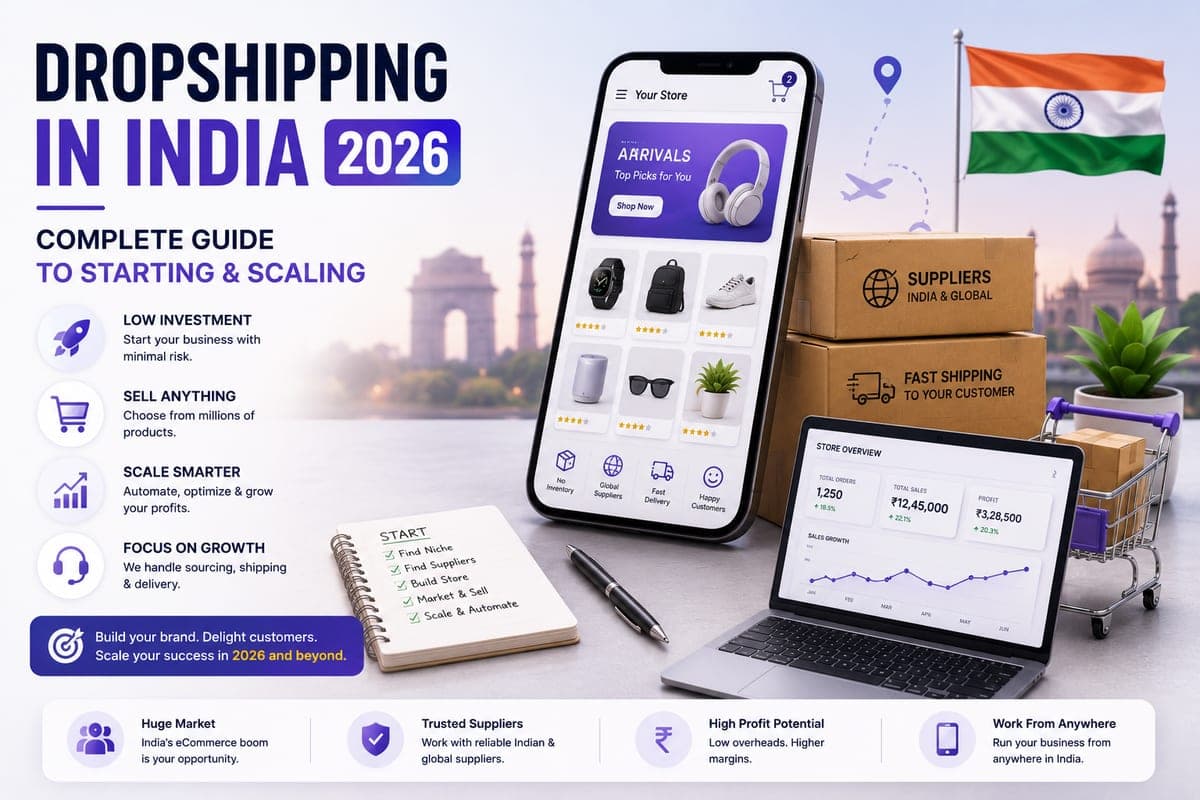
Dropshipping in India has moved out of the YouTube tutorial era and into a real business model. In 2026, you have a deep domestic market of 200+ million online shoppers, a fast-maturing supplier ecosystem in textiles, beauty, wellness, electronics, and handcrafts, payment rails like UPI that work flawlessly, and a logistics layer (Delhivery, Shadowfax, Ecom Express, Bluedart) that can deliver across the country reliably. The opportunity is bigger than it has ever been. So is the competition.
This guide is the complete playbook for dropshipping in India in 2026, what it is, whether it is legal, what it actually costs to start, the platforms and suppliers to use, the legal and tax setup, common mistakes, and the operational systems you need to scale beyond the first 20 orders a day. If you are considering starting, or you have already started and want to grow it into a real business, this article walks through every layer.
What Is Dropshipping?
Dropshipping is a retail fulfillment model where you sell products without holding any inventory. When a customer places an order on your store, you forward the order to your supplier, who ships it directly to the customer, usually under your branding. You never see, touch, or warehouse the product.
Your job is the front end: marketing, customer experience, branding, order management, returns. The supplier's job is the back end: stock, packing, and dispatch.
The model works for three reasons. One, capital required is dramatically lower than traditional retail because you do not buy stock upfront. Two, you can test new products in days instead of months. Three, you can sell catalogs much larger than you could ever stock yourself.
It also has structural weaknesses: thin margins, dependence on supplier reliability, and low defensibility against competitors with the same suppliers. The brands that win at dropshipping turn it from a model into a real business by adding brand, customer experience, and operational excellence on top.
Is Dropshipping Legal in India?
Yes. Dropshipping is fully legal in India in 2026. There is no specific law banning or restricting it. What is required is normal business compliance:
- GST registration if your turnover crosses the threshold (currently ₹40 lakh for most goods, lower for services and certain states)
- Import-Export Code (IEC) from the Directorate General of Foreign Trade if you sell internationally or source from abroad
- Category-specific licenses, FSSAI for food and supplements, cosmetic registration under the Drugs and Cosmetics Act for beauty, and so on
- Marketplace compliance if you sell on Amazon, Flipkart, Meesho, etc., each has its own seller policies
The mistake first-timers make is treating dropshipping as somehow exempt from normal business rules. It is not. The Indian tax department and marketplace compliance teams treat dropshippers exactly like any other seller. Get the basics right early and the business runs clean.
The Indian Dropshipping Market in 2026
India is one of the fastest-growing dropshipping markets in the world. Three structural reasons:
One: Ecommerce penetration. India crossed 200 million online shoppers years ago and is still adding millions every quarter. Tier-2 and tier-3 cities are now the fastest-growing online buyer cohort, opening up massive untapped demand for non-metro-priced products.
Two: Supplier depth. Decades of manufacturing strength in textiles (Tirupur, Surat, Ludhiana), Ayurveda (Kerala, Uttarakhand), jewelry (Jaipur), handicrafts (Rajasthan, Bengal), and electronics (Noida, Bengaluru) means there is almost no consumer category without a credible Indian supplier base. The Confederation of Indian Industry has documented the export uplift in many of these categories.
Three: Infrastructure maturity. UPI handles billions of monthly transactions seamlessly. Indian 3PLs deliver to 27,000+ pincodes. Shopify, Amazon, Flipkart, and Meesho all have mature seller ecosystems. Logistics costs continue to drop.
The result is that the same business that needed ₹25 lakh in seed capital to launch a decade ago can now be tested with ₹50,000 and scaled with ₹2 to 5 lakh.
How Dropshipping Works in India: The Full Flow
Here is the order flow, step by step:
- Customer places an order on your store (Shopify, WooCommerce, your own site) or a marketplace listing (Meesho, Amazon, Flipkart).
- Order is captured in your order management system.
- Stock is verified with the supplier (ideally via API, otherwise via real-time feed).
- Order is forwarded to the supplier with the customer's shipping address.
- Supplier picks and packs the order, often with your branded label or blind packaging.
- Carrier picks up (Delhivery, Shadowfax, Bluedart, India Post, etc.) and tracking number is generated.
- Tracking is pushed back to your store and to the customer.
- Customer receives the order, usually in 3 to 7 days for domestic, 7 to 14 days for international.
- Returns are processed if required, with disposition routed back to the supplier or to a returns center.
Every step is a place where something can go wrong. Stock mismatches, wrong-supplier shipments, branding leaks (the supplier's marketing material inside your parcel), late tracking pushes, missed return windows, each of these creates customer complaints, refunds, or marketplace penalties. This is why operational systems matter so much in dropshipping. Nventory's dropshipping module is built specifically to automate this entire flow so you are not running it through WhatsApp messages and Google Sheets.
How Much Does It Cost to Start Dropshipping in India?
Honest numbers for 2026:
Bootstrap setup (₹25,000 to ₹50,000):
- Shopify Basic or equivalent, ₹2,000 to ₹4,000/month
- A domain, ₹800 to ₹2,000/year
- Brand logo and basic design, ₹2,000 to ₹10,000
- Sample orders from 2 to 3 suppliers, ₹5,000 to ₹15,000
- Initial marketing budget, ₹15,000 to ₹25,000
Serious launch (₹2,00,000 to ₹5,00,000):
Add a proper marketing budget, a professional website, social ads, influencer collaborations, and an order management system that scales past 20 orders/day.
The trap to avoid: Spending money on courses promising overnight wealth. The real money in a dropshipping business is product research, supplier relationships, ad testing discipline, and operational tooling, not a ₹15,000 course.
Choosing the Right Platform
Your platform decision shapes the next two years of your business. Here are the main options.
Shopify: The default for serious operators. Best-in-class theme ecosystem, app library, payment integrations, and reporting. Subscription cost (~₹2,000 to ₹6,000/month) is fully justified if you are scaling.
WooCommerce: Free to start, runs on WordPress, more setup work but cheaper at scale. Good if you already know WordPress.
Meesho: Native dropshipping ecosystem for India. Easy onboarding, large supplier catalog, instant access to traffic. Lower margins because of platform dynamics.
Amazon India and Flipkart: Required as additional channels once you have a winning product, but generally not where you start a dropshipping business from scratch. Account suspension risk is higher with poorly-managed dropshipping.
Etsy: Best for handcrafted, vintage, or artisanal Indian products with international appeal.
Your own site (custom-built): Only makes sense after you have proven a category and need flexibility Shopify cannot offer.
Most successful dropshippers run two or three platforms simultaneously. Combined with multichannel order management, this becomes a real operation rather than a juggling act.
Finding and Vetting Suppliers
This is where most dropshipping businesses live or die. The full deep-dive lives in our companion guide on drop shipping suppliers in India, but the summary:
Where to find them: IndiaMART, TradeIndia, industry trade fairs (IIGF, IHGF), regional manufacturing clusters, dropshipping aggregators (GlowRoad, Shop101, Roposo Clout), LinkedIn outreach, DGFT exporter registers.
How to vet them: GSTIN verification on the official GST portal, years in business, manufacturing vs. trading status (verify with factory photos and Google Maps address), sample orders to multiple addresses, branded label and invoice check, stock update frequency, return policy in writing, response time benchmark on WhatsApp, references from existing dropshipper clients.
The 5-minute red flag check: Refuses to share GSTIN; no physical address; prices look impossibly low; demands UPI payment to a personal account; cannot show a factory; vague return policy; brand-new company with no online footprint.
Any two of these together: walk away.
Best Categories for Dropshipping in India
Some categories simply dropship better than others from India in 2026:
- Ethnic and fusion fashion (kurtas, sarees, dupattas), high global demand, strong margins
- Ayurveda and natural wellness, growing global category, high LTV
- Handcrafted home decor, premium positioning, low competition
- Imitation jewelry, high margin, manageable size for shipping
- Yoga and meditation products, globally relevant, India-credible
- Spices and food essentials (FSSAI-compliant), repeat purchase
- Print-on-demand apparel, zero inventory risk
- Tech accessories, high volume potential
- Beauty and skincare, high reorder rates, big margins
- Pet products, fast-growing, low competition in India
Avoid (until you have operational maturity): footwear (high return rates), supplements without proper licensing, glassware (damage rates), and any category requiring extensive size variants until you have a returns process figured out.
The Real Economics of Dropshipping
Here is the unflinching math on a typical ₹500 dropshipping order:
- Product cost from supplier: ₹200 to ₹250 (40 to 50%)
- Marketplace fee or payment gateway: ₹15 to ₹50
- Shipping (if not included in price): ₹50 to ₹100
- Marketing cost (allocated): ₹100 to ₹150
- Returns and refunds (averaged): ₹20 to ₹50
- Your net profit: ₹50 to ₹150 (10 to 30%)
This is why scale matters in dropshipping. 50 orders a day at ₹100 profit is ₹5,000/day or ₹1.5 lakh/month. 500 orders a day at the same margin is ₹15 lakh/month. The mathematics of dropshipping reward operators who can scale the volume.
Compounding effects matter too. As you grow, you get better supplier terms, lower CPM on ads, lower CAC through repeat customers and SEO, and better carrier rates. Operators who survive the first six months typically see margins improve 30 to 50% by month 12 from scale effects alone.
Legal and Tax Setup for Dropshipping in India
The compliance basics for 2026:
GST registration. Mandatory if your turnover crosses ₹40 lakh for goods (lower for some states and for services). Even before that, voluntary registration is worth considering once you are doing serious volume, because GST input credits offset your costs.
Income tax. Profits are taxable as business income. If you operate as a proprietorship, taxed at individual slabs. As a private limited company, at corporate rates. Most starting dropshippers stay as a proprietorship for the first 12 to 18 months for simplicity, then convert.
Import-Export Code (IEC). Mandatory if you sell internationally. Free and quick to obtain from DGFT.
Category licenses. FSSAI for food, cosmetic registration for beauty, AYUSH for Ayurvedic products. Skipping these can get your seller account suspended or trigger regulatory action.
Marketplace compliance. Read seller policies for each platform you sell on. They differ. Amazon's policies on dropshipping are stricter than Meesho's.
Bookkeeping. Hire an accountant or use software like Zoho Books or QuickBooks (which integrates with Nventory so your sales data flows automatically into accounting). Clean books from day one save you compliance pain later.
Marketing a Dropshipping Business in India
Most beginners overthink the product and underspend on marketing. Reality: in 2026, the unit economics of dropshipping are set on the marketing side, not the supplier side.
Channels that work in India in 2026:
- Meta ads (Facebook + Instagram), still the dominant performance channel for D2C in India
- Google Shopping, high-intent, captures buyers actively searching
- Influencer marketing, small/micro-influencers on Instagram and YouTube are punching well above their weight
- SEO and content marketing, slow but compounds; the highest-LTV traffic source
- WhatsApp marketing, open rates are extraordinary, churn is real
- Marketplace SEO, ranking on Amazon and Flipkart inside your category
A practical starting allocation for a new dropshipping business: 60% Meta ads, 20% Google Shopping, 10% influencer, 10% organic/SEO.
Scaling Past the First 20 Orders a Day
This is where the dropshipping dream meets operational reality. The first 20 orders a day, you can run on willpower and spreadsheets. The next 200 require systems. The gap is where most dropshippers stall.
The operational layers you need:
1. Real-time inventory sync with suppliers. Manual stock updates kill you with cancellations.
2. A unified order management system. Nventory's OMS brings orders from every channel into one queue.
3. Smart order routing. If you have multiple suppliers or even multiple warehouses (for popular SKUs you stock yourself), you need automated routing rules. See Nventory's smart routing.
4. Carrier rate-shopping. Stop using a single carrier. Native multi-carrier integrations save 8 to 15% on shipping costs.
5. Returns workflow. Self-serve returns portal, fast disposition, supplier coordination.
6. Data analytics. What is your best-selling SKU? Worst-returning? Most profitable? You should be able to answer all three in five minutes.
7. Customer support automation. Auto-replies, tracking pages, status updates. Cuts support volume by 40 to 60%.
A unified cloud-based inventory and order management platform collapses most of this into a single tool.
The Future of Dropshipping in India
Three trends are reshaping the landscape in 2026 and beyond.
One: Quality and brand are winning. The "post a generic AliExpress product and run ads" playbook is dying. Customers expect real branding, real customer service, and real product quality. Dropshippers who build genuine brands are pulling away.
Two: Quick commerce is changing the model. Quick commerce platforms have raised consumer expectations on delivery speed. Dropshipping cannot match 10-minute delivery, but it can compete on selection and price in considered-purchase categories.
Three: Social commerce is the new front door. Meesho's growth, TikTok Shop's launch, and Instagram Shopping's expansion mean discovery and purchase happen increasingly inside social platforms. Dropshippers who master social commerce are growing 3 to 5x faster than those stuck on Shopify-only.
The dropshipping business that succeeds in 2026 looks more like a real D2C brand than the YouTube-tutorial version of dropshipping. Brand, operational excellence, and channel diversification, not just a flashy ad on a generic product.
Final Word
Dropshipping in India in 2026 is no longer a side hustle waiting to be discovered. It is a real, competitive, increasingly professional business model, one that rewards operators who treat it like a business and crushes those who treat it like a get-rich scheme. The fundamentals are simple: pick a category with margin, vet your suppliers ruthlessly, build a brand customers want to buy from twice, and put systems in place before you actually need them.
If you are running, or about to run, a dropshipping operation across multiple channels and suppliers, see how Nventory automates dropshipping operations, browse the full integration list, or start free to put your stock, orders, and shipping on one source of truth.
Frequently Asked Questions
Yes, but margins are thinner than they were five years ago. Successful dropshipping businesses in India in 2026 run net margins of 10 to 25% after marketing, with the best operators clearing higher through brand premium and repeat purchase. The hobbyist version is rarely profitable; the disciplined version absolutely is.
A bootstrap test can be done with ₹25,000 to ₹50,000. A serious launch with realistic marketing budget and proper tooling needs ₹2 to 5 lakh in the first 90 days.
You can, until you cross the GST turnover threshold (₹40 lakh for goods in most states). Below that, registration is voluntary but often worth it for input credit benefits and credibility with suppliers.
For domestic India, Shopify and Meesho are the dominant choices. For international selling, Shopify with Amazon as a secondary channel. Most successful operators run multiple platforms simultaneously.
Most disciplined operators see breakeven between months 4 and 9, depending on category, marketing skill, and supplier quality. The first six months are typically reinvestment, not profit-taking.
Yes. You need an Import-Export Code (IEC), the right courier partner (DHL, FedEx, India Post International), clarity on customs and import duties for the destination country, and ideally a platform that supports multi-currency pricing.
Related Articles
View all
PO Systems for Small Business: What They Do and How to Choose One
How purchase order systems work, when a small business actually needs one, the four types available, and a checklist for choosing between them.
Best Inventory Management Software in India in 2026: Matched by Business Model
Best inventory management software in India, matched by business model, honest pricing, and what top Indian ecommerce operators actually run in 2026.