Dropshipping Suppliers in India: How to Find and Vet Them in 2026
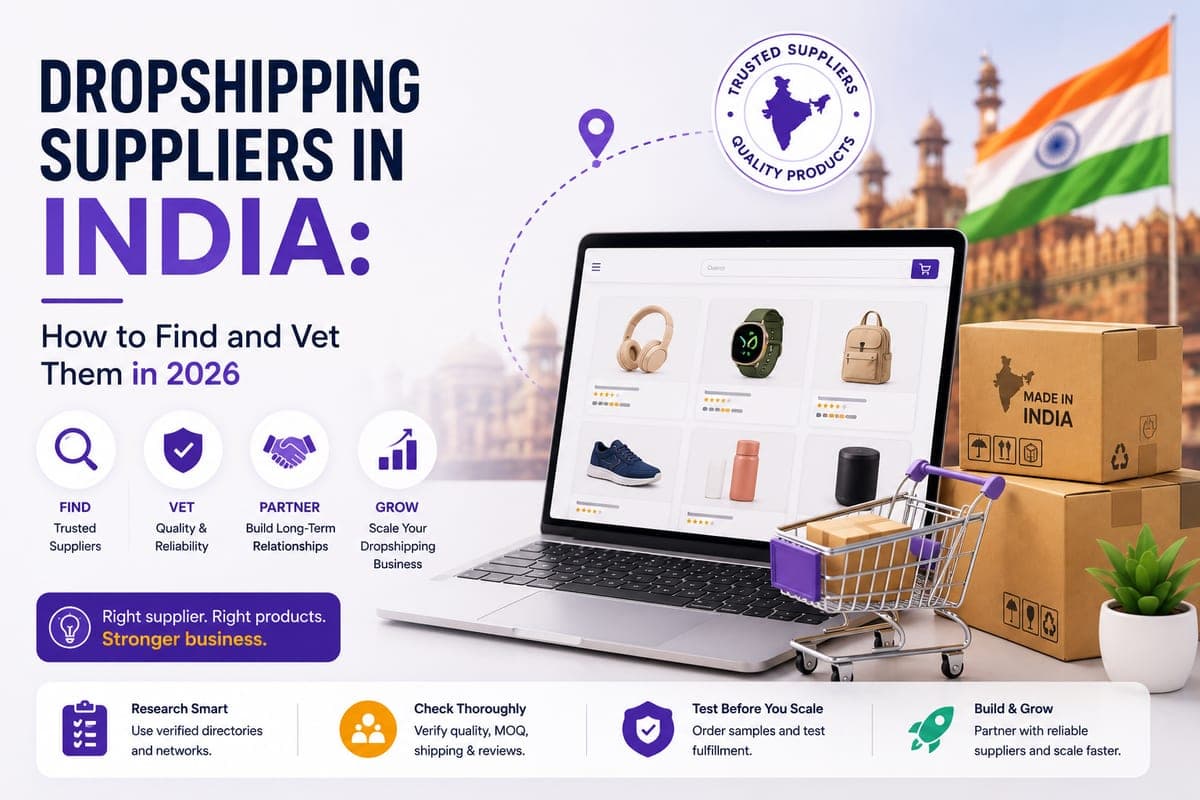
If you are starting a dropshipping business and selling into India, or selling Indian-made products to the world, the choice of supplier will decide everything. Margins, delivery times, return rates, customer reviews, account suspensions on Amazon and Flipkart, even whether the business survives its first six months. A great product with a bad supplier dies. A modest product with a reliable supplier scales.
This guide walks through how to find drop shipping suppliers in India, how to vet them so you do not get burned, the categories that actually work for dropshipping in 2026, and the operational systems that separate a hobby store from a real business. Whether you are sourcing for a Shopify D2C brand, an Amazon FBM operation, or a Meesho-style social commerce play, the playbook below applies.
What Is a Dropshipping Supplier?
A dropshipping supplier is a wholesaler or manufacturer who holds inventory, accepts orders from you (the retailer), and ships those orders directly to your end customer, usually under your brand name. You never touch the product. Your job is marketing, customer experience, and order routing. Their job is stock and dispatch.
In India, the supplier ecosystem is unusually deep. Decades of manufacturing in textile hubs (Tirupur, Surat, Ludhiana), leather (Kanpur, Chennai), electronics (Noida, Bengaluru), Ayurveda and wellness (Kerala, Uttarakhand), home decor (Jaipur, Moradabad), and handicrafts (West Bengal, Rajasthan) means there is almost no consumer category where you cannot find a credible Indian supplier.
That depth is also the problem. With tens of thousands of options, beginners waste months chasing the wrong tier of supplier, usually middlemen pretending to be manufacturers, and end up with thin margins and unreliable delivery.
Why India Is Becoming a Global Dropshipping Hub
India's dropshipping ecosystem has matured fast for three structural reasons.
First, the China+1 sourcing shift after 2020 sent global brands looking for an alternative manufacturing base, and India absorbed a meaningful share, particularly in textiles, leather goods, jewelry, and wellness. The Confederation of Indian Industry has tracked the resulting export uplift across multiple categories.
Second, domestic ecommerce penetration crossed a tipping point. With over 200 million online shoppers and growing tier-2 and tier-3 city demand, India is no longer just a sourcing market, it is also a destination market large enough to dropship into.
Third, payment infrastructure (UPI), logistics (Delhivery, Shadowfax, Ecom Express, Bluedart, India Post), and platform ecosystems (Shopify, Amazon India, Flipkart, Meesho, JioMart) reached a level of reliability where dropshipping is operationally viable end-to-end.
Combined, this makes India one of the most interesting dropshipping geographies in the world in 2026.
Types of Dropshipping Suppliers in India
Not all suppliers are the same. Understanding the tiers is the first step to picking the right one.
1. Manufacturers
The original source, factories that produce the goods. Best margins, lowest unit costs, but typically demand minimum order quantities (MOQs), longer onboarding, and limited willingness to do small drop-ship orders unless you commit to volume. Best for established sellers ready to commit.
2. Wholesalers / Distributors
Buy in bulk from manufacturers and resell to retailers. Higher unit cost than the factory, but no MOQ pressure and they are usually set up to handle dropshipping logistics. The sweet spot for most new dropshippers.
3. Dropshipping Aggregator Platforms
Aggregator marketplaces that connect retailers to thousands of pre-vetted Indian suppliers in one interface. Examples include GlowRoad, Meesho (supplier side), Roposo Clout, Shop101, and IndiaMART's verified supplier filters. Convenient, fast to onboard, but margins are tighter because everyone has access to the same catalog.
4. Print-on-Demand Suppliers
A specialized sub-category, they print designs on blank products (t-shirts, mugs, posters, phone cases) and ship per order. Good entry point because there is no inventory risk at all. Indian POD options have grown significantly.
5. Local Trading Companies / Middlemen
Companies that resell other people's products with a markup. Sometimes useful for niche access, but often a margin trap. Identifying and removing middlemen from your supply chain is one of the biggest profit unlocks for a dropshipping business.
Where to Find Drop Shipping Suppliers in India
You will not find the best suppliers through a Google search. They do not need to advertise. Use these channels instead.
IndiaMART and TradeIndia. The two largest B2B marketplaces in India. Filter by verified suppliers, year of establishment, and export experience. Treat the first 20 results as a starting point, not the final list.
Industry trade fairs. IIGF (International India Garment Fair), IHGF (Indian Handicrafts and Gifts Fair), India Expo Mart events, and category-specific exhibitions are where serious manufacturers show up in person. One day at a trade fair beats six weeks of cold outreach.
Industry clusters. Going directly to the regional cluster, Tirupur for knitwear, Surat for sarees and synthetics, Moradabad for brassware, Jaipur for jewelry, Sivakasi for fireworks/printing, gives you access to the actual factory floor.
Government export portals. DGFT (Directorate General of Foreign Trade) and the Federation of Indian Export Organisations maintain registers of registered exporters with verifiable credentials.
Dropshipping aggregator platforms. GlowRoad, Shop101, Roposo Clout, Baapstore, useful for first-month launches when you need catalog breadth.
LinkedIn and direct outreach. Search for "Director, [Category] Manufacturing, India" and message decision-makers directly. Response rates are higher than you expect because most factory owners are looking to diversify revenue.
Marketplace seller research. Identify products selling well on Amazon, Flipkart, and Meesho. Use seller info or reverse-image search to find the underlying manufacturer.
How to Vet a Dropshipping Supplier (The Checklist Most Beginners Skip)
This is where most dropshipping businesses live or die. Run every prospective supplier through this checklist before you send a single order their way.
1. GST and registration verification. Ask for their GSTIN and verify it on the official GST portal. A supplier unwilling to share GST is not a supplier.
2. Years in business. Anything under 3 years is a risk; under 1 year is a gamble. The Ministry of Corporate Affairs portal lets you check company registration date.
3. Manufacturing vs. trading. Ask directly. Ask for factory photos with their company signage. Ask for the address. Then verify on Google Maps. Middlemen evade these questions; manufacturers welcome them.
4. Sample orders. Place 3 to 5 sample orders to different addresses before committing. Inspect quality, packaging, delivery time, and unboxing experience.
5. Test their dropshipping process. Place orders under your store branding (or test branding) and confirm:
- Did they ship with a branded label, or did they include their own marketing material?
- Was the invoice generic or did it reveal your supplier?
- Were tracking IDs shared promptly?
6. Stock reliability. Ask how often they update stock. A supplier who refreshes stock data daily (or via API) is far safer than one who sends a CSV monthly. Stock sync issues are the single biggest cause of cancellations in Indian dropshipping.
7. Return and refund policy. Get it in writing. India has high return rates on apparel and footwear (20 to 35% in some categories). A supplier without a clear return path will leave you eating losses.
8. Communication speed. WhatsApp response within 4 hours during business hours is the minimum. Slow responders become disasters during peak season.
9. References. Ask for two existing dropshipper clients. Call them. Ask about disputes.
10. Payment terms. Avoid suppliers who demand full prepayment for every order until you have a 60-day track record. Standard is 50% advance, 50% on dispatch, with credit terms unlocked after relationship maturity.
Top Categories That Work for Dropshipping from India in 2026
Some categories simply dropship better than others from India. Based on margin structure, return rates, and shipping reliability, the strongest categories right now are:
- Ethnic and fusion fashion (kurtas, sarees, dupattas), global demand, strong margins
- Ayurveda and natural wellness, high LTV, growing global category
- Handcrafted home decor, premium positioning, low competition
- Imitation jewelry, high margin, manageable size for shipping
- Yoga and meditation products, globally relevant, India-credible
- Spices and food essentials (within India, subject to FSSAI compliance)
- Print-on-demand apparel, zero inventory risk
- Tech accessories (cables, holders, small gadgets), high volume potential
- Beauty and skincare, high reorder rates
- Pet products, fast-growing category with low competition in India
Avoid categories with high return rates (footwear, fitted apparel), high regulatory friction (medicines, supplements without FSSAI/AYUSH approval), or high shipping damage rates (glassware, ceramics over a certain size) until you have operational maturity.
How to Operate a Dropshipping Business Without Chaos
Finding a good supplier is half the problem. The other half is running the operation when you scale past 20 orders a day. This is where most beginners drown.
The core operational problem in dropshipping is that you do not own the inventory but you are accountable for the customer experience. Your supplier's stock-out is your overselling. Your supplier's delay is your refund request. Your supplier's wrong shipment is your return.
The way to stay in control is a unified order management layer that connects:
- Your storefronts (Shopify, your own site)
- Your marketplaces (Amazon, Flipkart, Meesho)
- Your suppliers' stock data (via API, feed, or CSV import)
- Your shipping carriers (Delhivery, Shadowfax, Bluedart, etc.)
This is exactly what Nventory's dropshipping module is built for, automating purchase orders, syncing supplier inventory, managing blind shipping, and pushing orders through without manual intervention. Combined with real-time inventory sync and smart order routing, you can run multiple suppliers and multiple channels as a single operation rather than a constant fire drill.
For sellers operating across India and abroad, Nventory's product feeds also let you push catalog data to platforms like Google Shopping, Flipkart, and international marketplaces in the format each requires, without manual file work.
Legal and Compliance Essentials
Dropshipping in India is legal, but there are compliance fundamentals you cannot ignore.
- GST registration is mandatory if your turnover crosses the threshold (₹40 lakh for goods in most states; lower for some). Get a GSTIN before scaling.
- Import-Export Code (IEC) from DGFT if you sell internationally.
- FSSAI license for any food, supplement, or wellness product.
- Cosmetic registration for beauty products under the Drugs and Cosmetics Act.
- Marketplace compliance, Amazon, Flipkart, and Meesho each have their own seller policies for dropshipping. Read them before listing.
Skipping these is a short-term saving and a long-term tax problem.
Red Flags: How to Spot a Bad Supplier in 5 Minutes
These signals consistently predict trouble:
- Refuses to share GSTIN
- No physical address, only a phone number
- Prices look too good to be true (50%+ below market)
- Communicates only on WhatsApp, never email or paper
- Cannot show a factory or even photos of one
- Pressures you to pay quickly via UPI to a personal account
- No samples allowed before bulk commitment
- Vague return policy or none at all
- "Brand new" company with no online footprint
Any two of these together: walk away.
Quick Commerce, Marketplaces, and the Dropshipping Future
The dropshipping landscape in India is shifting fast. Two forces are reshaping it.
The rise of quick commerce means dropshipping for last-mile speed-sensitive categories is becoming harder, you cannot dropship something in 10 minutes. So dropshippers are pivoting toward considered-purchase categories where 3 to 5 day delivery is acceptable.
The growth of social commerce, Meesho, Instagram Shopping, Facebook Shop, has made dropshipping more accessible than ever, but also more competitive. Differentiation is shifting from price to brand, packaging, and customer experience.
Both of these trends reward operators who have their backend together, real-time stock, fast supplier coordination, clean returns, and one unified view of orders. They punish operators winging it from a spreadsheet.
Final Word
Finding drop shipping suppliers in India is not the hard part. Vetting them properly, building a relationship that survives scale, and putting an operational layer underneath that keeps stock, orders, and shipping in lockstep, that is what separates dropshipping businesses that grow from ones that quietly close.
If you are running multiple suppliers across multiple channels, see how Nventory unifies dropshipping operations, browse the full integrations list, or start free to put your stock data on one source of truth.
Frequently Asked Questions
Yes. Dropshipping is fully legal in India provided you are registered for GST (when applicable), have an Import-Export Code for international sales, and comply with category-specific regulations (FSSAI for food, cosmetic registration for beauty, etc.).
A bootstrap setup, Shopify subscription, a few sample orders, basic marketing, can be started for ₹25,000 to ₹50,000. Serious operations with marketing spend and a proper OMS layer usually run ₹2 to 5 lakh in the first 90 days.
Yes. You will need an Import-Export Code (IEC), the right courier partner (DHL, FedEx, India Post International), and clarity on customs and import duties in the destination country. Average delivery times are 7 to 14 days unless you pre-stage stock with a fulfillment partner abroad.
For domestic India: Meesho and Shopify are the dominant starting points. For global selling: Shopify is standard, with Amazon (under FBM) and Etsy (for handcrafted goods) as strong complements.
Most operators see breakeven between months 4 and 9, depending on category, marketing skill, and supplier quality. A bad supplier can stretch this to never.
Related Articles
View all
PO Systems for Small Business: What They Do and How to Choose One
How purchase order systems work, when a small business actually needs one, the four types available, and a checklist for choosing between them.
Best Inventory Management Software in India in 2026: Matched by Business Model
Best inventory management software in India, matched by business model, honest pricing, and what top Indian ecommerce operators actually run in 2026.