Order Management System Software: The Definitive 2026 Reference for Scaling Brands
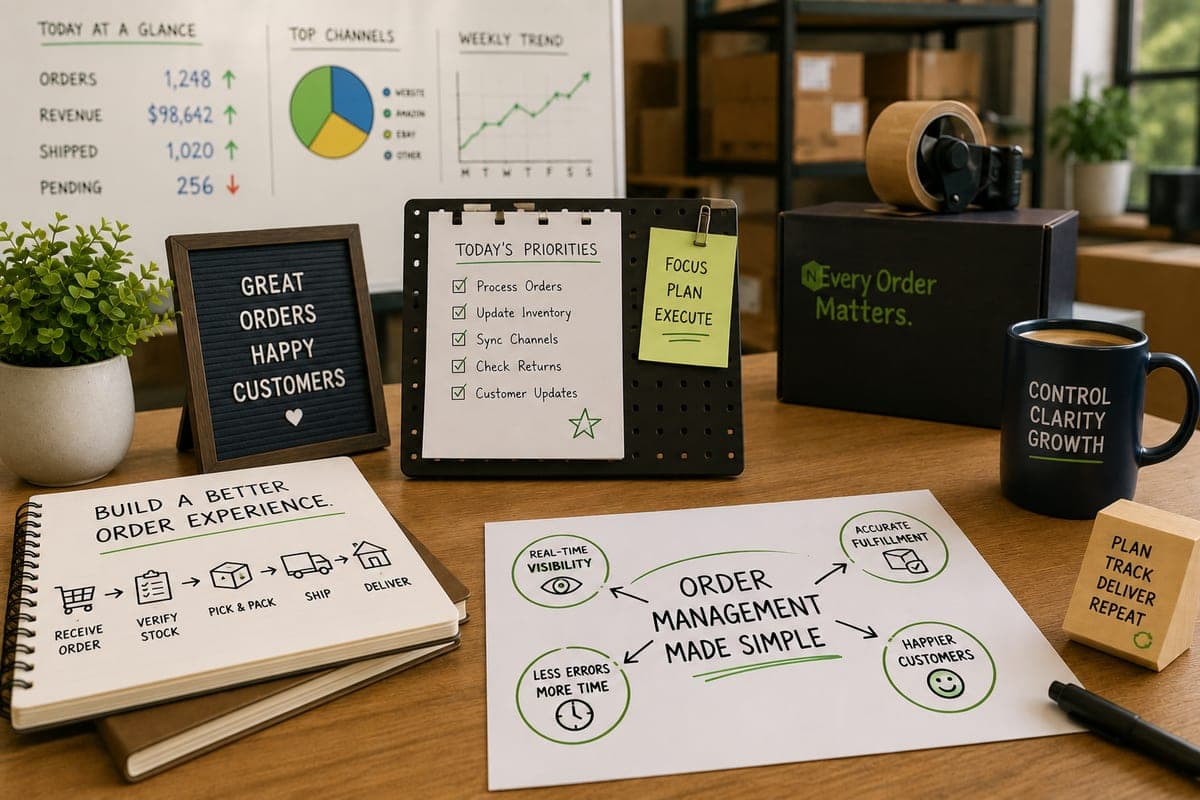
There is a moment every growing ecommerce brand recognizes. Orders are arriving from five different channels. The team is copying and pasting between tabs to figure out which warehouse has stock for which order. A marketplace warning has arrived about late dispatch. A customer is asking about an order that exists in two systems with different statuses. And somewhere on the horizon, peak season is approaching.
That moment has a name, and order management system software is what resolves it.
In 2026, order management system software has become the operational centerpiece of every brand selling across more than one channel, fulfilling from more than one location, or serving customers who expect same-day accuracy on their order status. The category has matured from basic order tracking into intelligent fulfillment orchestration, platforms that route orders dynamically, forecast demand ahead of it, automate the carrier decision on every shipment, and handle returns as a revenue-preserving workflow rather than a cost center.
This is the definitive reference. It covers what order management system software is, how it works at the engineering level, what separates excellent platforms from adequate ones, which tier fits which business, the specific capabilities that matter in the US market and globally, the AI layer that is now reshaping the category, and the evaluation framework that holds up in real-world trials. Whether you are evaluating your first OMS, replacing one that is breaking under growth, or benchmarking your current platform against 2026 standards, this is the guide.
Key Takeaways
- Order management system software centralizes orders, inventory, fulfillment, and returns from every sales channel into one real-time operational platform
- Sub-5-second sync across all connected channels is the 2026 engineering baseline, anything slower creates overselling risk under normal operating conditions
- The OMS is distinct from ERP, WMS, and IMS, each is a separate category with different scope; conflating them causes both overpurchasing and underpurchasing
- AI has moved from optional to standard, intelligent order routing, demand forecasting, and anomaly detection are now baseline expectations, not premium features
- Distributed order management (DOM), the ability to route orders dynamically across warehouses, stores, and dropship suppliers in real time, is the defining capability separating 2026 platforms from 2020 platforms
- The right tier depends on business model and order volume, a platform built for enterprise logistics will underserve a D2C brand; a platform built for early-stage ecommerce will break a multichannel operation
- Agentic commerce is reshaping how OMS platforms are evaluated, brands now need platforms that can serve as the operational foundation for AI agents making routine fulfillment decisions autonomously
What Is Order Management System Software?
Order management system software (OMS software) is a platform that manages the complete lifecycle of a customer order, from the moment it is placed on any sales channel through fulfillment, delivery, and post-delivery returns or exchanges, within a single, unified system.
An order management system is software that centralizes the capture, orchestration, and fulfillment of customer orders across every sales channel. Unlike an ERP, which manages financial records and back-office operations, an OMS focuses on the buyer-facing fulfillment experience: what was ordered, where it should ship from, and what happens when something goes wrong. Unlike an ecommerce platform, which handles the storefront and checkout, an OMS manages everything that occurs after the order is confirmed.
In practical terms, order management system software does seven things simultaneously:
- Pulls orders from every connected channel, website, marketplace, retail POS, B2B portal, social commerce, in real time
- Validates each order against live inventory, payment status, and fulfillment rules
- Routes each order to the optimal fulfillment location based on configurable logic
- Coordinates carrier selection, label generation, and shipment dispatch
- Pushes tracking status back to the originating channel and to the customer
- Manages returns from customer initiation through disposition and stock re-injection
- Reports on every operational metric that matters, order accuracy, cycle time, cost per order, on-time delivery, return rate
What unites these functions is a single source of truth: one database that every channel, warehouse, carrier, and team member reads from and writes to. The absence of that unified record is precisely the operational problem order management system software exists to solve.
How Order Management System Software Works: The Engineering
Understanding how order management system software is engineered, not just what it does, matters because the failure modes of poorly-built platforms are exactly where real operational losses happen. Most vendor pages describe the outcome. This section explains the mechanism.
The Webhook Architecture
When a customer places an order on Amazon, Amazon's servers fire a webhook, a real-time HTTP notification, to every connected system the moment the order is confirmed. The OMS receives order details via API or webhook covering order capture and validation, the system pulls in orders from wherever they originate, whether that is a website, Amazon, a sales rep's phone call, or a retail partner.
Systems that poll for new orders on a schedule (every 5, 15, or 30 minutes) are fundamentally slower and more failure-prone than webhook-driven systems. Sub-5-second order capture is the 2026 baseline. Anything slower introduces latency into every downstream decision.
Inventory Reservation and Locking
The moment an order is captured and validated, the system reserves the ordered inventory. This reservation must happen with a locking mechanism, a brief lock on the SKU that prevents two channels from selling the same unit in the same millisecond. Without proper locking, race conditions cause overselling even when sync is technically "real-time." This is the most commonly underspecified engineering detail in OMS platforms, and the failure mode that causes the most expensive customer-facing incidents during peak periods.
Intelligent Order Routing
The routing decision, which warehouse, 3PL, FBA node, dropship supplier, or retail store fulfills each order, is where the best platforms separate from the adequate ones. A basic routing engine sends orders to the nearest warehouse with stock. A sophisticated routing engine factors:
- Real-time stock availability across every fulfillment node
- Shipping cost per carrier and service level
- Delivery promise to the customer
- Warehouse capacity and current throughput
- Channel-specific rules (Amazon orders to FBA, D2C orders to owned warehouse)
- Whether a split shipment or a single shipment is more cost-effective
For enterprise retailers, the relevant evolution is distributed order management (DOM): the ability to route orders dynamically across a network of warehouses, distribution centers, stores, and dropship suppliers in real time, based on configurable rules for cost, speed, and service level.
Nventory's order routing engine implements this logic across your connected fulfillment nodes simultaneously, with rules operators can configure without engineering support.
Carrier Integration and Rate Shopping
A fully capable order management system software connects to carrier APIs, UPS, FedEx, DHL, USPS in North America and Europe and appropriate regional carriers for other markets, generates labels, arranges pickup, and rate-shops across carriers per order. Rate-shopping across carriers typically saves 8 to 15% on total shipping costs at scale.
Tracking Push and Status Management
Tracking numbers generated at dispatch flow back through the OMS to the originating channel and to the customer. For Amazon specifically, valid tracking must be pushed within a defined window, missing this window damages Valid Tracking Rate, a key seller health metric. For TikTok Shop and Walmart, equivalent SLAs exist with equivalent enforcement.
Returns Orchestration
Robust order management system software treats returns as a mainline workflow, not an afterthought. A customer initiates a return. The platform generates a Return Merchandise Authorization (RMA), issues a prepaid return label through the carrier integration, receives the item at the appropriate location, runs an inspection workflow, makes a disposition decision (restock, refurbish, liquidate, dispose), re-injects restockable inventory within 24 to 48 hours, and processes the refund or exchange. This entire flow should happen within the order management system software, not across email threads and separate systems.
OMS Software vs. ERP vs. WMS vs. IMS: The Honest Distinctions
These categories are consistently conflated in purchasing conversations. Understanding the precise scope of each prevents both overpurchasing and underpurchasing when evaluating order management system software.
Order Management System (OMS) Software
Manages the order lifecycle, from customer placement through fulfillment, tracking, and returns. Scope: customer-facing order experience. Order management system software is purpose-built for the buyer-to-fulfillment flow.
Inventory Management System (IMS)
Tracks stock levels, locations, and movements across every place inventory is held. Scope: stock accuracy and replenishment. Modern platforms typically bundle OMS and IMS together because the two are functionally inseparable, every routing decision depends on live inventory data.
Warehouse Management System (WMS)
Manages physical operations inside a warehouse, receiving, putaway, pick paths, packing stations, slotting, cycle counting. Scope: warehouse floor execution. A WMS works beneath an OMS, executing the physical instructions the OMS dispatches.
Enterprise Resource Planning (ERP)
A broad business suite covering finance, HR, procurement, manufacturing, and sometimes inventory and orders as modules within a larger system. Scope: entire business operations. ERPs become the right architecture when financial and organizational complexity outgrows specialized tools, typically around $50M annual revenue for product businesses.
The practical decision for most growing brands:
- Under $5M revenue: OMS + IMS bundled in one platform, integrating with accounting software
- $5M to $50M: Unified OMS + IMS, potentially a WMS for large warehouse operations
- Above $50M: Consider ERP integration, but many brands still prefer best-of-breed OMS + ERP rather than ERP-native order management
The mistake is purchasing an ERP when a specialized OMS is the right tool, overpaying for two years and underusing most of what you are paying for.
The AI Layer: What Actually Matters in 2026
Artificial intelligence has moved from a premium feature in order management system software to a baseline expectation. AI capabilities should be near the top of your evaluation criteria. In 2026, AI-powered automation handles routine decisions, so your team can focus on the exceptions that require human judgment. As agentic commerce grows and AI handles more routine order routing, categorization, and fulfillment decisions, the competitive advantage shifts to teams that can adapt workflows quickly, not those locked into rigid systems built for last year's requirements.
Here is the honest breakdown of which AI capabilities are genuinely valuable in 2026 OMS platforms and which are marketing noise.
Genuinely Valuable AI Capabilities
Demand Forecasting
AI-driven prediction of order volume by SKU, channel, and season, factoring in historical patterns, promotional calendars, external signals, and supplier lead times. Research from Harvard Business Review shows retailers using AI-driven demand forecasting see 20 to 50% reductions in combined stockouts and overstocks compared to manual or rules-based forecasting. This is measurable, material ROI.
Anomaly Detection
Identifying when a SKU is selling 5 to 10x its normal baseline before humans notice, catching viral product demand, unexpected stockouts, and supplier feed failures in real time. Without anomaly detection, these situations are discovered when a customer complains or a marketplace listing gets suppressed.
Dynamic Routing Optimization
Routing decisions that factor real-time carrier performance, weather disruptions, warehouse throughput capacity, and delivery promise in addition to static rules. Dynamic routing closes the gap between configured rules and real-world fulfillment conditions.
Conversational Operations
The shift from "log into a dashboard" to "ask via WhatsApp or Slack" is operationally significant. Warehouse teams that query stock levels, check order status, and trigger workflows through a messaging interface they already use operate faster than teams requiring portal access. Nventory's AI Suite implements this through WhatsApp, genuinely useful for distributed operations teams across time zones.
Marketing-Noise AI
Generic "AI-powered insights" that surface the same data a filtered report would. Chatbot customer service built on decision trees rather than genuine language understanding. AI features requiring months of training data configuration before producing anything useful.
The test: ask any vendor to demonstrate their AI features in a scenario directly relevant to your operation, with your data. If the demo cannot deviate from a script, the feature is not production-ready.
Agentic Commerce: The Next Evolution of OMS Software
Agentic commerce, where AI agents autonomously handle routine commercial transactions on behalf of consumers, is not a distant concept. In 2026, a meaningful and growing share of consumer product research and purchasing begins with a question to ChatGPT, Perplexity, or Gemini rather than a Google search. According to data from Adobe Analytics, AI-driven referral traffic to retail sites grew over 4,700% year-over-year between 2024 and 2025.
The order management system software implication is significant: as AI agents handle more consumer purchasing, the platform needs to be architected to receive and fulfill orders initiated by AI agents, not just human checkout flows. This means:
- API-first architecture so AI agents can query real-time inventory and pricing
- Real-time availability confirmation before order commitment
- Structured product data in formats AI engines can parse and act on
- Fulfillment SLAs that are programmatically enforceable, not just contractually stated
Brands that build their OMS on a flexible, API-first platform now will be positioned for agentic commerce at scale. Brands on rigid, UI-first platforms will face significant re-architecture work.
Who Needs What Tier of OMS Software
Order management system software is not a single category, it is a spectrum. Using the wrong tier in either direction is expensive: too much platform means paying for capability you will not use for two years; too little platform means a migration under operational stress.
Tier 1: Platform-Native Order Management
What it is: Shopify's order screen, WooCommerce's order manager, BigCommerce's native fulfillment tools. Included with the ecommerce platform subscription.
Shopify captures orders, tracks fulfillment status, and keeps simple inventory in sync across online and in-person sales. It excels at order capture and customer-facing commerce with bulletproof features for checkout, payments, and order status tracking. For manufacturers and distributors, Shopify typically works best as the storefront while order and inventory complexity lives elsewhere. Once you have multi-warehouse allocation, production dependencies, or structured purchasing needs, Shopify functions as the front end to your operational system of choice.
Right for: Single-channel D2C brands, under 50 orders/day, single warehouse.
Outgrown when: You add a second sales channel, exceed 50 orders/day, or need intelligent routing.
Tier 2: Specialized Fulfillment Apps
What it is: Third-party apps that extend native order management, multichannel sync tools, basic shipping automation. This tier of order management system software serves brands that have outgrown native platform tools but are not yet at multichannel scale.
Right for: Growing D2C brands hitting the ceiling of native tools. Typically 50 to 200 orders/day, 2 to 3 channels.
Outgrown when: Three or more channels, two or more warehouses, or 200+ orders/day. App fragmentation and sync failures become frequent.
Tier 3: Unified OMS + IMS Platforms
What it is: Dedicated platforms combining order management, inventory management, multi-warehouse routing, native carrier integration, and returns in one system.
Right for: Serious multichannel ecommerce brands, 3+ channels, 1+ warehouses, 200 to 10,000 orders/day, D2C plus marketplace plus potentially retail, quick commerce, or B2B.
Nventory operates in this tier, built specifically for the operational complexity of multichannel ecommerce brands, with sub-5-second real-time sync across 30+ channels, intelligent routing across your connected fulfillment nodes, and an AI Suite that meets operations teams where they already work.
Outgrown when: Revenue exceeds $50M or operational complexity reaches enterprise scale.
Tier 4: Enterprise Distributed Order Management
What it is: Manhattan Associates, IBM Sterling, KIBO, Oracle OMS, SAP Commerce Cloud. These platforms offer omnichannel fulfillment capabilities including BOPIS, ship-from-store, distributed order management, and multi-node inventory visibility, alongside B2B order management depth covering purchase order support, approval workflows, account-specific contract pricing, and native AI agent functionality.
Right for: Enterprise retailers with 10,000+ daily orders, complex fulfillment networks, significant B2B operations, and global regulatory requirements.
Most operators reading this guide live in Tier 2 transitioning to Tier 3, or solidly in Tier 3. Enterprise Tier 4 platforms are a different procurement process, different vendors, different implementation partners, different cost structures entirely.
Order Management System Software by Business Model
The right order management system software configuration varies significantly by operational model. No single platform setup fits every business, here is what each model genuinely needs from its OMS.
D2C Ecommerce Brands
Core requirements: Real-time inventory sync across owned storefront and any marketplace channels. Native carrier rate-shopping. Clean returns portal. Basic demand forecasting. Shopify or WooCommerce native integration.
What changes at scale: When a D2C brand crosses 500 orders/day or adds a third channel, intelligent routing across warehouse locations and a more sophisticated returns workflow become necessary.
US market specifics: US D2C brands typically fulfill via UPS, FedEx, and USPS with dimensional weight pricing, carrier rate-shopping per order is high-ROI at any meaningful volume. USPS Ground Advantage has reshaped economics for lightweight parcels; the order management system software should surface this rate automatically on every eligible shipment.
Multichannel Marketplace Sellers
Core requirements: Sub-5-second multichannel sync across Amazon, eBay, Walmart, TikTok Shop, and Etsy simultaneously. Amazon FBA and FBM routing rules. Valid Tracking Rate management. Seller health metric visibility.
What changes at scale: The number of marketplace-specific rules compounds. Amazon US, Amazon UK, and Amazon India all have different SLAs and penalty thresholds. The OMS needs to handle these as separate rule sets within one system.
US market specifics: Amazon US is the highest-stakes marketplace in the world for seller account health enforcement. Order management system software must push tracking within Amazon's required window, missing this is one of the fastest ways to damage ranking and account standing.
B2B and Wholesale Operations
Core requirements: Customer-specific pricing enforced at the system level. Minimum order quantity validation. Credit terms management alongside order release. EDI compliance for retail and distributor partners. Quote-to-order workflow.
US market specifics: EDI compliance for major US retailers (Walmart, Target, Costco) requires strict ASN (Advance Ship Notice), PO acknowledgment, and invoice formats. Order management system software needs either native EDI support or a clean integration to an EDI middleware to serve US retail partners.
Dropshipping Operations
Core requirements: Real-time supplier stock feed integration. Automated order forwarding to suppliers within seconds of placement. Multi-supplier routing. Blind shipping compliance. Tracking pull-back from supplier into the storefront within the SLA window.
What changes at scale: Multi-supplier routing intelligence, routing each order to the optimal supplier based on stock, cost, geography, and SLA, becomes essential once you work with three or more dropship suppliers simultaneously. Nventory's dropshipping module handles this flow natively.
Omnichannel Retail (Online + Physical Stores)
Core requirements: Unified inventory pool visible to all channels simultaneously. Ship-from-store capability. Buy-online-pickup-in-store (BOPIS). Cross-channel returns regardless of original purchase channel. Real-time store stock visibility.
US market specifics: US consumers increasingly expect BOPIS as table stakes, research from the National Retail Federation consistently shows it as one of the top reasons consumers choose one retailer over another. The OMS must support it natively, not as a custom integration.
The 2026 Feature Checklist: What Separates Excellent From Adequate
Across every tier and business model, these are the capabilities that genuinely differentiate order management system software in 2026. Use this checklist when evaluating any platform, it covers what demos rarely show and what real operations depend on.
Real-Time Sync Architecture (under 5 seconds)
Not "near real-time" as a marketing term. Webhook-driven, event-based sync that propagates a stock change to every connected channel in under 5 seconds. Test this during the trial with a stopwatch.
Distributed Order Routing Engine
Rules-based logic factoring stock availability, shipping cost, carrier speed, warehouse capacity, and channel-specific requirements, not just geographic proximity. The sophistication of the routing engine is consistently the most under-evaluated capability in vendor selection.
Native Carrier Integration With Rate Shopping
Direct API connections to your actual carriers, UPS, FedEx, DHL, USPS for US/global and appropriate regional carriers per market. Rate-shopping per order.
AI-Driven Demand Forecasting
Baseline in 2026. If a vendor positions forecasting as a premium add-on, the platform is behind the category curve.
Conversational Operations Layer
WhatsApp, Slack, or equivalent interface for warehouse and operations teams to query stock, check order status, and trigger workflows without portal access. Particularly impactful for distributed teams across time zones and for emerging markets where messaging apps are the primary operational interface.
Mobile-Native Experience
A real mobile app, not a mobile-responsive web interface, for warehouse receiving, pick confirmation, stock adjustment, and order management. Test it on your actual warehouse floor, not in a demo environment.
Returns as a First-Class Workflow
Customer initiation, RMA, return label, receiving, inspection, disposition, stock re-injection, financial settlement, all within 48 hours of return arrival. Platforms where returns are manual workarounds create compounding inventory accuracy problems.
API-First Architecture
Order management system software built on a complete REST API covers every function available in the UI. In the agentic commerce era, the platform's API is what AI agents use to query inventory, place orders, and confirm fulfillment. Closed or limited APIs are a genuine strategic liability in 2026, the OMS API is now a front-facing commercial interface, not just a developer tool.
Multi-Currency and Multi-Region Support
For US brands selling internationally (or global brands serving the US market), the OMS must handle multi-currency pricing, multi-region tax calculations, international carrier selection, and customs data generation natively.
The US Market: What Specifically Matters
For brands entering or scaling in the US market, several requirements in order management system software are specific to the North American ecommerce environment. Global platforms vary widely in how well they address these, verifying them during the trial is essential.
Carrier ecosystem: UPS, FedEx, USPS, and DHL are the primary carriers. USPS Ground Advantage has become highly competitive for parcels under 1lb. Regional carriers (OnTrac, Lone Star Overnight, LSO, Spee-Dee) offer cost advantages in specific regions. An OMS with genuine multi-carrier rate-shopping captures these advantages automatically.
Amazon US compliance: Amazon US has among the strictest seller account health enforcement globally. Order Defect Rate under 1%, Late Dispatch Rate under 4%, Cancellation Rate under 2.5%, Valid Tracking Rate above 95%. These are not guidelines, they are enforced thresholds. The OMS needs to surface these metrics daily and flag drift before it becomes a warning.
Sales tax complexity: US sales tax has over 11,000 distinct taxing jurisdictions. Post-South Dakota v. Wayfair (2018), most ecommerce brands have economic nexus obligations across multiple states. The OMS needs either native tax calculation or a clean integration to Avalara or TaxJar.
Returns expectations: US consumers return roughly 20% of online purchases. According to the National Retail Federation, US retail returns totaled approximately $685 billion in 2024. An OMS with a self-serve returns portal and fast stock re-injection is now table stakes, not a differentiator.
BOPIS and ship-from-store: Increasingly expected by US consumers across retail categories. The OMS must support store inventory as a fulfillment node alongside warehouses.
How to Evaluate Order Management System Software
The evaluation framework that reveals real capability, not choreographed demos.
Step 1: Define Your Tier
Use the tier framework above. Are you at Tier 1 (native tools), transitioning to Tier 2 (fulfillment apps), solidly at Tier 3 (unified OMS platform), or evaluating enterprise Tier 4? The tier determines your vendor shortlist before you look at a single demo.
Step 2: Establish Your Three Non-Negotiables
Every business has structural requirements. Common non-negotiables:
- Sub-5-second multichannel sync (ecommerce)
- Amazon FBA and FBM routing in one system (marketplace sellers)
- EDI compliance (B2B with retail partners)
- Multi-currency support (international brands)
- GST-compliant invoicing (India operations)
- Native USPS, UPS, FedEx rate-shopping (US operations)
Any platform that cannot satisfy your three non-negotiables is eliminated before the demo.
Step 3: Test Sync Latency With a Stopwatch
Ask every vendor the specific end-to-end sync latency from a sale on Channel A to stock update visible on Channel B. Then test it yourself during the trial. Place a real test order. Time the decrement across every connected channel. The stopwatch is more reliable than any vendor claim.
Step 4: Test the Edge Cases That Reveal Real Engineering
Demos show the happy path. Your business runs on edge cases.
- Place simultaneous orders on two channels for the same low-stock SKU, does the OMS prevent overselling?
- Process a return end-to-end, how long from customer initiation to restocked inventory?
- Create a bundle or kit, does the OMS decrement all components correctly?
- Route an order manually to a non-default warehouse, how many steps?
- Generate a pick list for 50 orders, is it optimized for warehouse flow or sequential?
Step 5: Evaluate the AI Features Honestly
Ask for a live demonstration of each AI feature using data similar to your own, not a pre-loaded demo dataset. Demand forecasting, anomaly detection, and routing optimization should all be demonstrable with real-world inputs. If the vendor cannot deviate from a scripted demo, the feature is not production-ready.
Step 6: Calculate Total Cost of Ownership
Beyond the subscription fee:
- Implementation and onboarding
- Per-user seat costs at your team's projected size
- Per-integration or per-channel fees
- Add-on module costs (returns portal, B2B, forecasting)
- Integration to your accounting platform (QuickBooks, Xero, NetSuite)
- Migration cost from your current platform
A healthy OMS total cost of ownership is 0.3 to 1% of annual revenue.
Step 7: Run a 14-Day Trial With Your Real Data
Every credible Tier 3 platform offers a free trial. Use it with your actual SKUs, your actual orders, and a live channel connection. Not a clean demo dataset. Two weeks of real operations reveals more than ten sales calls. Start Nventory's 14-day trial, no credit card required.
The Signals That Tell You It's Time for a New OMS
The signs that your current order management system software is actively costing you revenue every month are consistent across business types. If three or more of these apply, the cost of inaction now exceeds the cost of upgrading:
- You spend more than 5 hours per week reconciling orders across channels
- You have oversold on more than one channel in the last 90 days
- Your team has more than two people whose jobs primarily involve tracking orders manually
- Your Amazon seller health has been flagged for cancellations or late dispatch
- You are dreading adding a new sales channel because of the operational overhead
- Peak season requires extra headcount just to manage order coordination
- Returns are processed in batches rather than within 24 to 48 hours of arrival
- You cannot answer "how many units of this SKU are available across all locations right now" in under 30 seconds
- Your warehouse team double-checks the system against physical stock because the system is not trusted
Nventory: Order Management System Software Built for Multichannel Ecommerce
Nventory is a multichannel inventory and order management platform, purpose-built order management system software for ecommerce brands operating across multiple sales channels and fulfillment locations. It operates at Tier 3, the unified OMS + IMS layer that sits above storefronts and below ERP, connecting every channel and fulfillment node into one real-time operational system.
What Nventory delivers:
Real-time inventory sync across 30+ channels, Shopify, WooCommerce, Amazon, eBay, TikTok Shop, Walmart, Etsy, and more, with sub-5-second latency and race-condition protection that prevents overselling even during simultaneous multi-channel sales spikes.
Dropshipping automation covering supplier stock feed integration, automated order forwarding, blind shipping enforcement, multi-supplier routing, and tracking pull-back, the complete supplier-side workflow in one module.
AI Suite with conversational operations, warehouse and operations teams query inventory, check order status, and trigger workflows through WhatsApp. No portal login required for routine operational queries.
Mobile-first with fully functional iOS and Android apps for inventory management, order processing, and operational visibility from anywhere.
Full integrations list covering accounting platforms (QuickBooks, Xero, NetSuite, Sage), sales channels, carriers, and third-party tools.
Final Word
Order management system software in 2026 is the operational centerpiece of every serious ecommerce brand, not a back-office utility, but the real-time intelligence layer that decides whether fulfillment scales with demand or collapses under it. The category has evolved from basic order tracking into distributed fulfillment orchestration, AI-driven decisioning, and agentic commerce readiness.
The brands that will lead their categories through the second half of 2026 and into 2027 are the ones building on OMS infrastructure designed for where the industry is heading, not patching systems designed for where it was. The right platform at the right tier, implemented properly, pays back within the first 60 days and compounds in operational efficiency from there.
If you operate across multiple channels, fulfill from multiple locations, or are planning to grow into either, see how Nventory delivers unified order management, real-time inventory sync, intelligent routing, native carrier integration, dropshipping automation, and conversational AI operations in one platform. Review pricing, browse the full integrations list, download the iOS app or Android app, or start a free 14-day trial with your real data.
Frequently Asked Questions
Order management system software is a platform that manages the complete lifecycle of a customer order, from placement on any sales channel through fulfillment, delivery, and post-delivery returns or exchanges, within a single, unified system. It replaces the disconnected spreadsheets, email threads, and channel-specific tools that break down when a business sells across multiple channels or fulfills from multiple locations.
Order management system software focuses on the order lifecycle and customer-facing fulfillment experience, what was ordered, where it ships from, and what happens with returns. An ERP is a broader business suite covering finance, HR, procurement, and manufacturing. Most ecommerce brands under $50M annual revenue benefit from specialized order management system software integrated with their accounting platform rather than an ERP that attempts to replace everything.
Distributed order management is the capability within advanced OMS platforms to route orders dynamically across a network of warehouses, distribution centers, retail stores, and dropship suppliers in real time, based on configurable rules for cost, speed, and service level. It is the defining evolution in OMS software between 2020 and 2026, enabled by real-time inventory visibility across the full fulfillment network.
Entry-tier platforms for small operations run $29 to $100 per month. Tier 3 unified OMS platforms for multichannel brands typically run $149 to $1,500 per month depending on order volume and features. Enterprise Tier 4 platforms require custom quotes that typically run well into five figures annually. A healthy total cost of ownership is 0.3 to 1% of annual revenue at operating scale.
The non-negotiable features in 2026: sub-5-second multichannel sync, distributed order routing engine, native multi-carrier integration with rate-shopping, AI-driven demand forecasting, conversational operations layer, mobile-native experience, returns as a first-class workflow, and API-first architecture for agentic commerce readiness. For US operations specifically: USPS/UPS/FedEx native integration, sales tax calculation, Amazon seller health metric tracking, and BOPIS support.
Yes. Modern Tier 3 platforms treat ecommerce storefronts and retail POS as equal channels feeding from one unified inventory pool, with ship-from-store, buy-online-pickup-in-store, and cross-channel returns supported natively. The key distinction is whether omnichannel capability was designed from the platform's foundation or added as a retrofit, the former holds under load; the latter does not.
For a single-channel operation under 5,000 SKUs, one to two weeks from signup to live. For multichannel, multi-warehouse brands implementing a full order management system software stack, four to eight weeks is realistic with proper data preparation. Enterprise implementations run three to twelve months. The single biggest variable is data cleanliness, clean SKU data before migration, not during.
They are closely related and often bundled in modern platforms. Inventory management software focuses on tracking stock levels, locations, and movements. Order management system software focuses on the order lifecycle, capture, routing, fulfillment, tracking, and returns. Both functions depend on the same real-time data, which is why modern order management system software platforms combine inventory and order management rather than treating them as separate products.
The best order management system software platforms in 2026 are being built with agentic commerce in mind. This requires API-first architecture so AI agents can query inventory and submit orders programmatically, real-time availability confirmation, and structured product data. Order management system software built on rigid, UI-first architectures will require significant re-architecture to serve as the operational foundation for agentic commerce.
A properly implemented OMS handles returns as a complete workflow: customer-initiated return request through a self-serve portal, RMA generation, prepaid return label (through the carrier integration), receiving at the appropriate fulfillment node, inspection and disposition decision (restock, refurbish, liquidate, dispose), stock re-injection within 24 to 48 hours, and financial settlement (refund or exchange). The entire flow should be automated within the OMS, not managed across email threads and separate systems.
Order management system software built for the US market includes: native integration with USPS, UPS, FedEx, and DHL; per-order carrier rate-shopping including dimensional weight calculation; Amazon US seller health metric tracking (Valid Tracking Rate, Order Defect Rate, Late Dispatch Rate); multi-state sales tax calculation or integration with Avalara or TaxJar; BOPIS and ship-from-store support; EDI compliance for major US retail partners; and returns workflows calibrated for US consumer return rates of 20%+.
Yes, a genuinely global OMS should handle US operations (USPS/UPS/FedEx, multi-state tax, Amazon US SLAs) and international operations (local carriers by region, currency conversion, customs data, regional marketplace integrations) from one platform. For India specifically, evaluate each vendor's live coverage of local marketplaces, quick commerce feeds, local carrier connectivity, COD reconciliation, and GST-compliant invoicing before shortlisting, since coverage varies significantly across platforms.
Related Articles
View all
PO Systems for Small Business: What They Do and How to Choose One
How purchase order systems work, when a small business actually needs one, the four types available, and a checklist for choosing between them.

Best Inventory Management Software in India in 2026: Matched by Business Model
Best inventory management software in India, matched by business model, honest pricing, and what top Indian ecommerce operators actually run in 2026.