Multichannel Inventory Sync: The Architecture Behind Scale
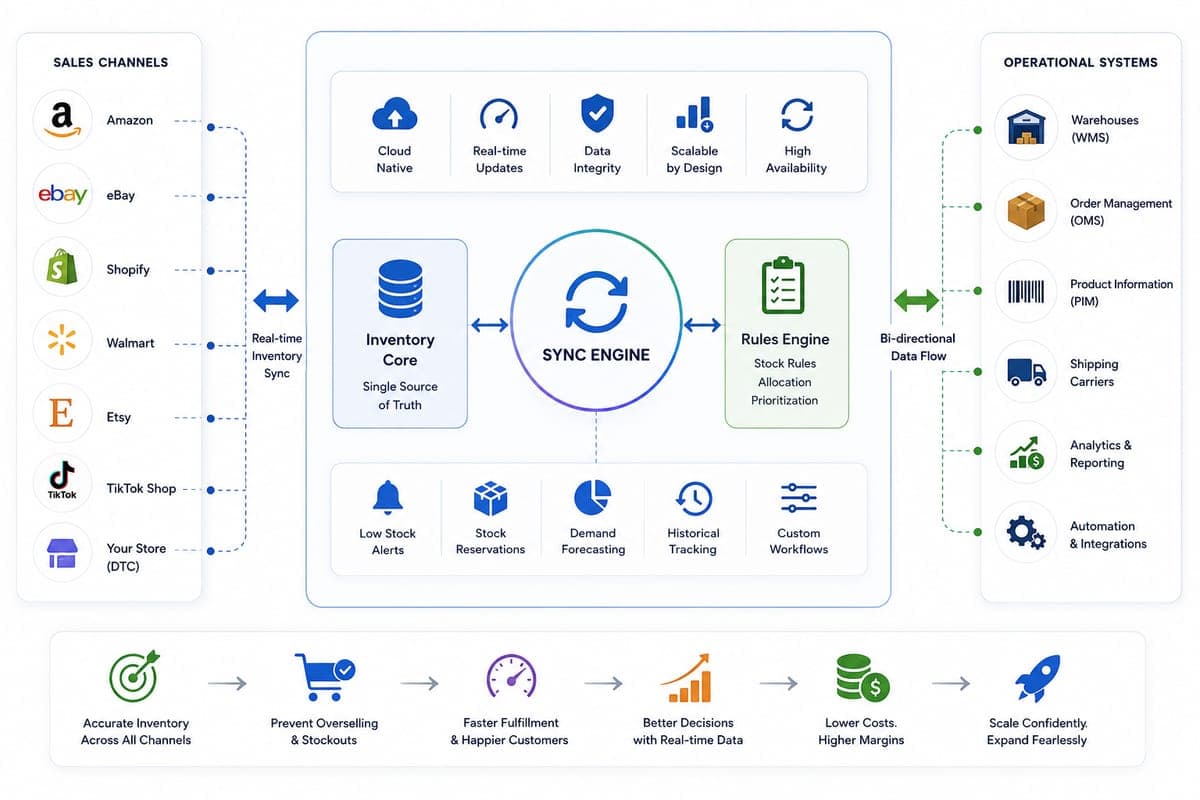
Multichannel inventory sync is the operational discipline that determines whether ecommerce brands can scale beyond their first channel without operational chaos. The discipline sounds simple, keep stock counts consistent across channels, but the implementation reality is brutal. Production-grade multichannel inventory sync requires solving multiple distributed systems problems simultaneously, and most tools claiming to handle it do not actually solve them. Operations running on inadequate sync architecture experience cancellation cascades, marketplace metric damage, and customer experience problems that no amount of operational discipline can fully compensate for.
This article walks through what multichannel inventory sync actually requires architecturally, the specific problems serious sync platforms have to solve, and how to evaluate options based on production behavior rather than marketing claims.
What Multichannel Inventory Sync Actually Has to Solve
The conceptual problem, keep stock counts consistent across channels, hides five technical subproblems that production-grade multichannel inventory sync has to handle.
Latency under load. Stock changes propagate fast enough that no channel oversells during high-velocity windows. The threshold gets set by the fastest channel in your stack. Amazon Lightning Deals can drain inventory in seconds; the sync layer has to keep up.
Idempotency under retries. Webhook delivery is at-least-once, not exactly-once. Without idempotency keys, retried webhook deliveries double-process stock changes, decrementing inventory more than once per actual sale.
Concurrency control. Two sales of the same SKU happening simultaneously across channels create race conditions. Without proper per-SKU locking, the second sale's stock change overwrites the first's, leaving inventory at +1 instead of -1 of correct values.
Event ordering. Webhook events arrive out of order. A sale event might arrive after the stock-adjust event that was supposed to precede it. Without ordering logic, the final state does not match physical reality.
Error recovery. APIs fail. Networks partition. Channels rate-limit. The sync layer needs graceful failure handling with retry logic and reconciliation passes that catch anything the real-time layer missed.
According to Cloudflare's documentation on webhooks, event-driven architectures handle these subproblems far more reliably than polling-based alternatives, but the architectural details inside event-driven implementations determine whether the system holds up under sustained peak load.
Why Polling-Based Sync Fundamentally Cannot Scale
Many tools market themselves as multichannel inventory sync platforms while using polling-based architecture underneath. Understanding why polling fundamentally cannot scale matters because polling-based tools will always disappoint at meaningful multichannel volume regardless of vendor optimism.
Polling-based sync checks each connected channel for changes every N minutes. The architecture is simple, debuggable, and predictable. It is also fundamentally limited.
The interval gap problem. If your polling interval is 15 minutes, your worst-case sync gap is 15 minutes. During that gap, channels can disagree, customers can buy products that already sold elsewhere, and overselling happens. No optimization within polling architecture closes the interval gap; only architectural change does.
The peak velocity problem. Peak sales periods produce inventory velocity that polling intervals cannot track. A SKU selling 40 units per minute during a flash sale loses accuracy completely under 15-minute polling. The sync architecture fundamentally cannot keep up.
The reconciliation lag problem. When polling produces incorrect states, reconciliation passes catch the errors eventually. The lag between error and reconciliation is the period when overselling, customer issues, and metric damage accumulate.
The scaling cost problem. Polling at faster intervals seems like the solution but produces other problems, API rate limit issues with marketplaces, increased server load, and more aggressive cost scaling. Faster polling is not real-time sync; it is just shorter intervals between gaps.
For multichannel ecommerce operations specifically, polling-based sync produces structural problems that operational discipline can mitigate but not eliminate.
The Architectural Foundation Production-Grade Sync Requires
Multichannel inventory sync that handles real-world scale shares specific architectural properties.
Webhook-driven primary updates. Each connected channel pushes events to the sync layer the moment they happen. The handler propagates updates outward in seconds. No polling intervals to fall behind during peak periods.
Idempotency keys on every event. Each event carries a unique identifier. The sync layer checks whether each event has been processed before applying it. Retries become safe; double-counting becomes impossible.
Per-SKU locking for concurrent updates. Updates to the same SKU serialize correctly. Updates to different SKUs parallelize. Race conditions during concurrent sales become structurally impossible.
Logical ordering with last-write-wins per SKU. Event timestamps from source systems determine final state, not arrival order at the sync layer. Out-of-order events produce correct final state.
Hybrid architecture with reconciliation passes. Webhook-driven primary sync supplemented by periodic reconciliation passes that catch anything the real-time layer missed. Pure real-time without reconciliation accumulates drift over time.
Comprehensive event logging with replay. Every event logged with timestamps, source attribution, and replay capability. Operators can diagnose any sync issue without going through vendor support.
Native channel integrations. Direct API connections to each channel rather than middleware-routed integrations. Native integrations have lower latency, better error handling, and faster recovery from platform changes.
For deeper context on the inventory sync architecture, see our inventory sync framework on the architecture that scales.
How Marketplace-Specific Requirements Shape Sync Architecture
Different marketplaces have different sync requirements that shape architecture decisions.
Amazon SP-API specifics. Amazon's punishing tolerance for overselling makes Amazon-aware sync critical. The architectural pattern is sub-5-second propagation to prevent Order Defect Rate damage. For deeper context, see our Amazon inventory management framework.
eBay Trading API specifics. eBay's defect rate sensitivity creates similar requirements. Multi-Variation Listings add complexity. For the eBay-specific perspective, see our eBay inventory management framework.
Walmart Marketplace specifics. Walmart's seller performance scorecard rewards fast sync and penalizes delays. The integration patterns differ from Amazon and eBay in specific ways.
TikTok Shop specifics. TikTok Shop's emerging integration ecosystem produces specific webhook delivery patterns and rate limit considerations.
Shopify specifics. Shopify's webhook delivery has specific retry behavior and ordering guarantees. Sync tools need to handle these correctly.
WooCommerce specifics. WooCommerce runs on WordPress with hosting-specific implications. Sync architecture needs to respect hosting limitations while delivering real-time performance.
Multichannel inventory sync platforms that handle marketplace-specific requirements correctly produce significantly better outcomes than generic sync tools applied across channels.
How Nventory Implements Multichannel Inventory Sync
Nventory.io is a webhook-driven multichannel inventory sync platform built around the architectural properties production-grade sync requires. The platform handles idempotency, ordering, locking, retry logic, and reconciliation at the infrastructure layer.
Sync propagation typically completes in under 5 seconds. Variations track at the SKU level. Every webhook event logs with replay capability. Native API integrations connect WooCommerce, Shopify, BigCommerce, Amazon, eBay, Walmart, TikTok Shop, Etsy, and 30+ other channels without middleware dependencies.
For WordPress and WooCommerce stores, download Nventory free from WordPress.org. For Shopify operations, install Nventory from the Shopify App Store. Both versions connect to the same multi-channel platform with identical architectural properties.
The architectural value is not just speed, it is that the complexity stays out of your storefront instance. The plugin or app stays lightweight; the platform handles everything else on dedicated infrastructure designed for high-velocity multichannel inventory sync.
According to Wikipedia's overview of inventory management, centralized data ownership across distributed channels is foundational to operational accuracy. Multichannel inventory sync done right embodies this principle by providing one canonical source of truth that channels read from rather than maintaining independent counts.
How to Verify Multichannel Inventory Sync Before Committing
Before committing to any multichannel inventory sync platform, run these specific verification tests on staging.
Test 1: Sync speed under burst load. Generate 50 synthetic orders within a 60-second window across multiple channels. Measure propagation time. Anything slower than 30 seconds suggests architectural problems.
Test 2: Concurrent SKU sales. Configure synthetic orders to hit the same SKU simultaneously across 2+ channels. Verify the final count matches reality. Race condition failures appear here.
Test 3: Webhook failure recovery. Configure a sandbox channel to deliberately fail webhook deliveries. Verify the platform retries correctly and surfaces persistent failures to operators.
Test 4: Idempotency verification. Trigger duplicate webhook deliveries (simulating retry scenarios). Verify the platform processes each event exactly once.
Test 5: Bulk operation handling. Bulk-update 500+ product stocks simultaneously. Verify all updates process correctly without dropping events.
Test 6: Audit trail accessibility. Query event logs for specific stock changes. Verify operators can see exactly what happened without going through support.
Platforms passing all six tests have production-grade architecture. Platforms failing two or more should be eliminated regardless of marketing claims.
Common Multichannel Inventory Sync Mistakes
A few patterns that produce sync failures at scale.
Trusting "real-time sync" marketing without verification. Many platforms market real-time sync but use polling underneath. Always verify on staging with specific latency measurements.
Picking based on integration count alone. "200+ integrations" usually means middleware. Native integrations to your specific channels matter more than broad coverage through middleware.
Skipping idempotency verification. Without explicit idempotency handling, retry scenarios produce double-counting that accumulates as drift.
Ignoring concurrency control. Without per-SKU locking, concurrent updates produce race conditions that manifest as random-seeming drift.
Underestimating ordering issues. Out-of-order events produce subtle data corruption that takes weeks to diagnose. Platforms handling ordering correctly are more reliable than platforms pretending ordering does not matter.
Final Thoughts
Multichannel inventory sync is a deceptively complex distributed systems engineering problem disguised as a simple business requirement. The architectures that work at scale share specific properties: webhook-driven, idempotent, ordered, concurrent-safe, reconciled, and natively integrated. Tools missing any of these properties will eventually fail under load. The cost of failure shows up as overselling, cancellation rates, marketplace penalties, and customer churn that no operational discipline can fully recover.
If you want to test multichannel inventory sync built around production-grade architectural principles, install Nventory on your platform of choice. For WordPress and WooCommerce stores, download Nventory free from WordPress.org. For Shopify stores, install Nventory from the Shopify App Store. Visit nventory.io to review the platform architecture and see how the implementation handles each subproblem.
Frequently Asked Questions
Webhook-driven primary updates with idempotency keys, per-SKU locking, logical ordering, hybrid reconciliation, comprehensive logging, and native channel integrations. Nventory implements all these, available on WordPress.org and the Shopify App Store.
Sub-5-second sync is the modern industry standard. Anything slower than 1 minute creates overselling risk during peak periods. Polling-based tools at 5 to 15 minute intervals are obsolete for serious multi-channel operations.
Production-grade platforms retry with exponential backoff, log the failure, and run periodic reconciliation passes to catch anything retries missed. Platforms that just log and move on accumulate stock drift silently.
Yes, when the architecture is right. The free Nventory tier handles production multichannel sync because the architectural foundation is built for it, not because feature completeness is artificially limited.
Technically yes, practically no for most teams. The five subproblems each take weeks to solve correctly. Buying a platform that already handles them is faster and lower-risk.
For any operation with multi-channel selling or meaningful order volume, yes. Polling architectures create overselling risk that no operational discipline can fully eliminate. Webhook-driven sync removes the structural cause.
Related Articles
View all
PO Systems for Small Business: What They Do and How to Choose One
How purchase order systems work, when a small business actually needs one, the four types available, and a checklist for choosing between them.

Best Inventory Management Software in India in 2026: Matched by Business Model
Best inventory management software in India, matched by business model, honest pricing, and what top Indian ecommerce operators actually run in 2026.