Meta's Muse Can Shop Your Shopify Store, but Amazon Blocked It. What Sellers Should Do
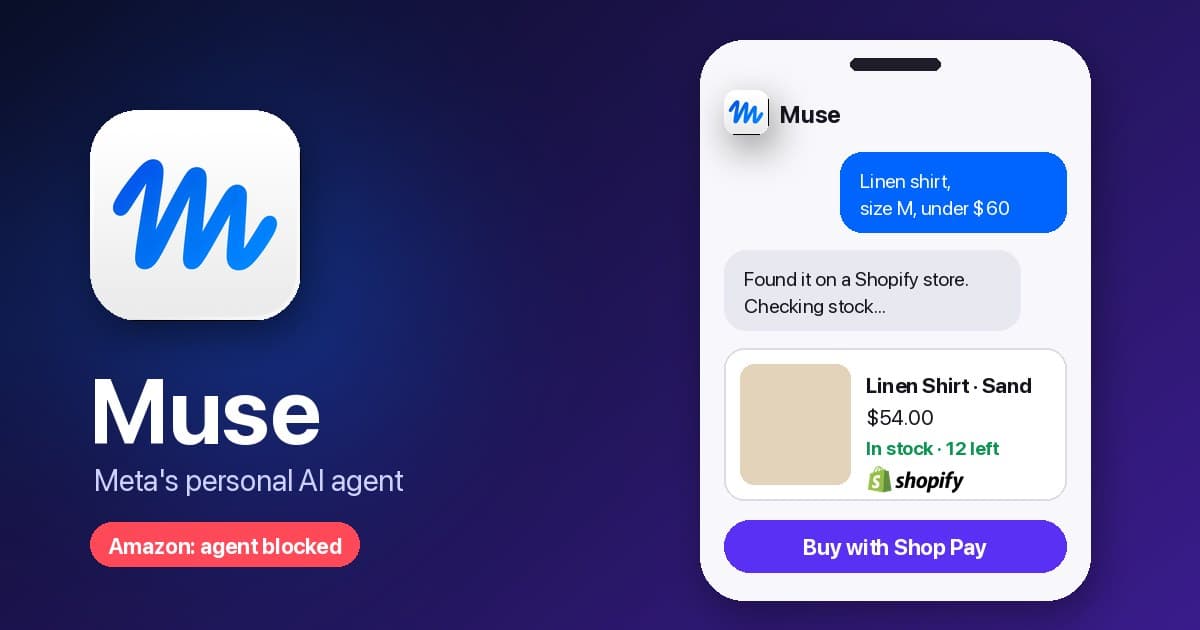
On the night of Sunday, September 20, people who asked Meta's new Muse agent to shop on Amazon got a pop-up instead: "Continued access by an unauthorized AI agent violates Amazon's Conditions of Use." That wording comes from GeekWire's report on Amazon blocking Muse. The next day, Shopify's chief executive Tobi Lütke posted that Shopify was "partnering deeply with Muse to enable agentic checkout with Shop Pay on all Shopify stores," as PYMNTS reported from the Shopify and Meta announcements.
So two of the places you sell took opposite sides within about a day. If your products are on Shopify, Meta Muse can probably find them and check out today, because Shopify's September 8 changelog entry says your products are "shared with Meta by default." If they are on Amazon, Muse is locked out.
This guide is for sellers who list in both places. It covers what Muse is, the ways it buys, why Amazon shut the door, and what the agent reads about your products. It also shows how to spot its orders, what changes for fraud and returns, and which settings to decide on. A worked example and a checklist close it out.
What's in this guide
- What Meta's Muse is
- How Muse finds and buys products
- Why Amazon blocked Muse
- What the split means if you sell on Shopify and Amazon
- What Muse reads about your products
- How to tell Muse orders and traffic apart
- Chargebacks, fraud and returns when an agent buys
- Choose your Muse settings on purpose
- Worked example: one shelf, three channels, one Friday
- What to do this week
What Meta's Muse is
Muse is a personal AI agent: software that carries out tasks for a person instead of only answering questions. Meta's launch announcement put it live in the US on September 8, 2026, on iOS, Android, the web at muse.ai and inside WhatsApp. You describe what you want in a chat. Muse makes a plan and does the steps.
For sellers, three lines in that announcement matter most. Muse "can open a browser, fill out forms, and negotiate" on a person's behalf. It "keeps working after people close the app." And it comes back for approval "before it sends an email or makes a purchase." So an order can be researched over hours, while the shopper is doing something else, and then confirmed with one tap.
The model underneath is Muse Spark. Meta announced Muse Spark on April 8, 2026 as the first model from Meta Superintelligence Labs, its new AI research group. Muse Spark first powered Meta's AI assistant. Muse is the agent built on top of it.
Muse is free for most use, though a payment card is needed to sign up. TechCrunch's launch coverage lists two paid plans, Power at $20 a month and Maximum at $100 a month, which buy more usage. Adoption was quick. CNN's hands-on test of Muse cited Sensor Tower data showing more than 2.5 million downloads, and Muse held the top spot among free iPhone apps.
Meta has also said how it plans to make money from all this. At Meta's Connect event on September 23, Mark Zuckerberg said Meta would keep Muse free "for a huge number of tokens, with the expectation that over time we will profit by taking a small fee from transactions," according to TechCrunch's roundup of the Connect announcements. When the business model is a cut of purchases, expect shopping to get more investment, not less.
How Muse finds and buys products
Muse doesn't buy the same way everywhere. How it buys depends on where the product lives.
1. Shopify stores, through Shopify Catalog
Shopify Catalog is Shopify's shared product database that AI shopping channels read from. Shopify's help page on selling on Meta says eligible stores have "direct checkout" switched on by default for Meta surfaces, "including Muse when available." A shopper can find your product and pay without leaving Muse. Shop Pay, Shopify's saved-details wallet, can appear as a payment option, and you don't need to switch it on separately for Muse.
A few details from that page change how you plan. Direct checkout is shown only to shoppers in the United States, Canada and Mexico. If the checkout needs information Muse can't collect, the shopper is sent to your own checkout inside Meta's in-app browser, with the cart kept. You remain the merchant of record, so fulfillment, returns and customer service stay with you.
At Connect, Meta's chief AI officer Alexandr Wang said Muse can reach the entire Shopify catalog and pay with Link and Shop Pay, with more support for PayPal. The same TechCrunch roundup lists new retail partners (Best Buy, Gap, Sephora, Walmart and Wayfair).
2. Every other website, through its own browser
Where there is no partnership, Muse uses a browser. Meta's technical write-up on how Muse is secured describes a Chromium-based browser running in a virtual machine (a private computer in Meta's cloud) for each user. A browser sub-agent reads your pages, moves through the site and fills in forms. The shopper can watch and take over at any time.
Payment runs through a wallet. The same write-up says that at checkout Muse issues a single-use card number "tied to that particular merchant, a particular dollar amount, and only valid for a limited period of time," and asks the shopper to approve every purchase. At launch that wallet was Link, built by Stripe.
Browser buying fails often in practice. CNN's tester found that Target "blocked autonomous clicks at checkout," so the reporter had to enter personal details by hand. Muse also stalled on a beauty-supply site that required a professional license number.
3. Facebook Marketplace
Muse's prompt ideas say it can message a Marketplace seller and "talk the price down against comparable listings." In CNN's test it only drafted a message for the user to send, though Meta told CNN it can negotiate within limits the user sets. If you sell surplus stock on Marketplace, some buyers may be agents working to a price ceiling.
| Where your product is | How Muse finds it | How the order is paid | What you control |
|---|---|---|---|
| Shopify store, direct checkout on (default) | Shopify Catalog | Shopify-powered checkout inside Muse; Shop Pay or another supported method | Catalog access and direct checkout switches in the Shopify admin |
| Shopify store, direct checkout off | Shopify Catalog | Shopper is sent to your normal checkout | Everything on your own checkout page |
| Other store platform or custom site | Web search and its own browser | Browser fills in your checkout with a single-use card from its wallet | Bot checks, CAPTCHAs, how easy your pages are to read |
| Big retail partners (Best Buy, Walmart and others) | Connectors built with Meta | Through the partner's connection | Only by partnering with Meta |
| Amazon | Product links from search engines only | Blocked | Amazon has decided for you |
| Facebook Marketplace | Watches listings the user asks about | Arranged with you, the seller | Your asking price and how you answer messages |
Muse is one of several agents now shopping for people. For how it compares with ChatGPT, Gemini, Alexa and the open-source agents, see our guide to how AI shopping agents buy.
Why Amazon blocked Muse
According to GeekWire, Amazon asked Meta to leave Amazon out of Muse, got no agreement, and then cut Muse off. Amazon gave three reasons. Meta never told Amazon that Muse would shop there. Muse doesn't identify itself when it browses. And it "appears to capture and store customer credentials," meaning shoppers' Amazon logins. Amazon also said Muse can reach account pages and order history when a user asks it to.
Amazon's spokesperson put the principle this way: "third-party applications that offer to make purchases on behalf of customers from other businesses should operate openly and respect service provider decisions about whether or not to participate."
Amazon had already written that rule down. The Amazon Conditions of Use, last updated August 14, 2026, include a section of Agent Terms. An agent must put "Agent/[agent name]" in the user agent string of every web request. (The user agent string is the label a browser sends to say what it is.) It may not mimic human typing or solve CAPTCHAs, the "prove you're human" puzzles. It must stop if Amazon asks it to.
Meta disputes the credentials point. Its launch post says Muse "has no visibility into people's passwords or payment methods" and that anything a user shares goes into secure storage the agent uses without seeing. Meta's security write-up adds that logins go to a separate credential service outside the part of the machine where the agent runs.
The block works. When The Register asked Muse to add an office chair to an Amazon cart, Muse reported an anti-bot wall and said it "didn't push past it, since the notice says continuing would violate Amazon's terms."
Money is part of the story too. GeekWire notes that Amazon earned more than $68 billion from advertising last year, and that income depends on shoppers seeing sponsored products on Amazon's pages. An agent that searches and buys for someone skips those pages. Amazon runs its own agents: GeekWire points out that its Buy for Me feature, which buys from brands' own websites, identifies itself and lets brands opt out.
There is a legal thread too. GeekWire notes that Amazon lost an injunction against Perplexity's Comet browser on appeal in August, when the court found the user, not the AI company, was the one accessing Amazon. Claims based on terms of service stayed open, which is why Amazon's pop-up cites its Conditions of Use.
What the split means if you sell on Shopify and Amazon
For a seller on both channels, the question is which of your storefronts an agent can reach.
Your Shopify store is the storefront Muse buys from. Some brands treat Amazon as the main channel and Shopify as a brochure: thinner descriptions, missing variants, stock that updates late. Muse sees that weaker version. If a Muse user asks for "a 6-quart enameled Dutch oven under $80 that ships by Friday," your Shopify data answers, not your Amazon listing.
Shoppers can still see your Amazon price. CNN found that although Amazon blocks Muse, the agent "can still retrieve product links through search engines." A user can be shown your Amazon listing next to your Shopify one and asked to choose. If Shopify is $6 dearer, the shopper can see it. Shopify's help page says Meta's direct checkout carries no fees beyond standard payment processing, so a Muse sale through Shopify usually keeps more margin than a marketplace sale. Decide your price gap on purpose instead of letting two separate pricing rules drift.
One shelf now has more doors. Agents keep working after the shopper closes the app, so Muse orders can land at 2am or in bursts. If Amazon, Shopify and a third channel draw on the same units, every channel's stock number has to change within seconds of a sale. Otherwise an agent can buy a unit another channel sold a minute earlier. Our guide to preventing overselling across Amazon, Shopify and eBay covers the setup.
Your own agents should follow Amazon's rules too. The Agent Terms cover any software acting autonomously on Amazon Services. If you run an operations agent such as OpenClaw for store operations or Hermes Agent, or hire one of xAI's Grok Bot teammates, connect it to Amazon through official seller APIs (the documented, approved way for software to talk to Amazon), not a browser that logs in as you.
| Question | Shopify | Amazon |
|---|---|---|
| Can Muse buy there? | Yes, through direct checkout, on by default | No, blocked since September 20 |
| Who decided? | Shopify, for eligible merchants; you can opt out | Amazon, for all sellers |
| Does the agent have to identify itself? | Orders come through a named Meta channel | Yes, "Agent/[name]" in every request under the Agent Terms |
| Extra fee per order | None beyond payment processing, per Shopify | Not applicable |
| Who handles returns and service | You, as merchant of record | Not applicable |
What Muse reads about your products
On Shopify, Muse reads what Shopify Catalog sends. Shopify's page on Catalog and product discovery lists the fields: title, description, options, images, price and availability, "structured in a way that AI agents can parse." Shopify says Catalog updates continuously, so stock and price should match across AI channels. If key details sit in custom fields (metafields), Shopify Catalog Mapping tells Catalog where to find them.
The help page for Meta adds two rules worth acting on. Put any legal disclosures in the first 6,000 characters of the product description, where Meta will show them. Keep your return and refund policy current, because Meta surfaces display it to shoppers.
Shopify stores also serve a file at /agents.md, plus /llms.txt copies, that tells visiting agents your store name, policies and where to find product data. You can edit these through theme templates. Open yours and check it says what you want an agent to repeat.
Meta's own apps are the other input. Meta says Muse can turn "a recipe reel the person saved on Instagram into a grocery list." Muse Spark's shopping mode in Meta AI draws on "the styling inspiration and brand storytelling already happening across our apps," and people can tag a brand to browse its public content. Your Instagram and Facebook posts are part of how Meta's assistants learn what you sell. Our earlier guide to Meta AI shopping and Instagram product data covers that side.
Off Shopify, Muse reads your live pages. Meta's write-up says the browser sub-agent sees "an accessibility tree snapshot of the page," the same structure screen readers use, not your raw code. A size picker built from unlabeled images, or an "Add to cart" icon with no text label, is hard for it to use. Clear text labels help screen-reader users and this agent alike.
For the basics, our free product feed validator catches missing prices, GTINs (the barcode numbers that identify a product) and broken image links.
How to tell Muse orders and traffic apart
On Shopify direct checkout, it's easy. Shopify's help page says orders placed on Meta surfaces "are attributed to Meta" and show in your admin like any other sales channel. Filter orders and reports by that channel.
Your analytics will undercount. The same page says Google Analytics and custom pixels "won't fire" in Meta's direct checkout. Only server-to-server events for checkout started and completed are sent. If you judge Instagram ads or influencer posts by Google Analytics conversions, Muse sales will be missing from that view. Use Shopify's channel report as the source of truth.
On other platforms, Muse carries no label. Amazon's complaint was that Muse doesn't identify itself. Stark Insider's look at what Muse runs on had the agent visit a page that echoes back request headers. It arrived as ordinary Chrome on Linux from a Cloudflare address, with nothing naming Muse. Meta hasn't published a way to verify Muse traffic, so treat that as one tester's result.
That leaves patterns: desktop Chrome-on-Linux sessions converting overnight, or a returning customer with a new card number on every order (single-use cards). Tag a sample of such orders by hand for a month to estimate the share before you build rules around it.
Chargebacks, fraud and returns when an agent buys
The card side is safer than it looks. The single-use numbers from Muse's wallet are locked to one merchant, one amount and a short time window. A stolen one is close to worthless, which gives card thieves little to work with.
Your fraud rules may still misfire. A new card, a cloud IP address (the network address the request comes from) and a Linux browser is the kind of combination fraud filters may score as risky. Review these orders by hand rather than auto-cancelling them. Rules keyed to "same customer, same card" will also stop matching, because the card changes every time.
Shoppers get extra protection that doesn't come from you. Link's purchase protections page lists damage, loss and theft cover up to $500 a claim, no-fee returns up to $250, price protection up to $500 and a refund guarantee up to $1,000. Link's insurance partner, Cover Genius, assesses these claims. The page doesn't describe any charge to merchants. Your own return policy still applies.
The bigger risk is the agent picking the wrong thing. It may choose the wrong size, color or pack count, or buy something the shopper can't use, like CNN's license-only shampoo. That shows up as returns, and sometimes as "I didn't order this" disputes. Two things help. Name every variant in plain words ("Queen, 90 x 90 in") and put restrictions in the description text. And remember that Muse shows the shopper "a complete audit trail" of what it did, but the shopper holds that record, not you. In a dispute, ask the customer to check it. For how these disputes cost more than the refund, see our breakdown of friendly-fraud chargeback costs.
Some products can't go through Meta's direct checkout at all. Shopify lists subscriptions, bundles, customizable products and business-to-business (wholesale) products, plus local delivery and in-store pickup. If you rely on those, check how they appear in Muse before a busy weekend.
Choose your Muse settings on purpose
Shopify made the first choice for you by switching Meta on. Each option below is a trade-off. On Shopify, the switches live under Sales channels, then Agentic: turn off "Allow Shopify to manage for me," click Meta, and change the settings.
| Setting | What Muse can do | What you give up |
|---|---|---|
| Catalog on, direct checkout on (default) | Find your products and complete the purchase inside Muse | Browser pixels, checkout blocks and required customer sign-in |
| Catalog on, direct checkout off | Find your products, then send the shopper to your checkout | Some sales from shoppers who won't take the extra step |
| Catalog off for Meta | Still find you through web search and crawling | Structured, up-to-date data in Muse's results |
| Product set to Unlisted | Nothing | Google and other search engines too, not only AI channels |
Off Shopify, the choice is about friction. You can't block Muse by name in robots.txt (the file that tells crawlers what to skip), because it doesn't announce a name, and Shopify notes those rules are only advisory anyway. A CAPTCHA or a "no automated checkout" rule can stop a browser agent, as Target's checkout did in CNN's test. So will a passkey login: Stark Insider's Muse couldn't sign in to Best Buy at the passkey step. Each of those may also turn away an agent that was about to pay full price. For most small brands, a sensible default is to let agents in and protect the steps that matter, such as stock accuracy and fraud review.
Worked example: one shelf, three channels, one Friday
Example (hypothetical numbers): a cookware brand sells a $64 enameled Dutch oven on Shopify, Amazon and eBay, all shipped from one warehouse. It uses an app that pushes stock counts to each channel every 15 minutes.
At 6:00pm on a Friday the shelf holds 8 units. A creator's reel about the pot starts spreading, and several Muse users ask their agents to buy it.
- 6:00 to 6:15pm: Amazon sells 6 units. The shelf now holds 2.
- Shopify still shows 8, because the next stock push is at 6:15.
- In the same 15 minutes Shopify takes 5 orders: 3 through Muse direct checkout and 2 from regular visitors.
In plain English: the brand promised 5 pots on Shopify but had only 2 left after Amazon's sales.
Units available after Amazon sales   = 8 - 6          = 2
Shopify orders in the stale window   = 3 Muse + 2 web = 5
Oversold units                       = 5 - 2          = 3

Cost per cancelled order (assumed)
  Profit lost on the sale           = $22
  Support time, 15 min at $24/hour   = $6
  Total per cancellation             = $28

Cost this Friday                     = 3 x $28        = $84
Cost over 8 peak weekends            = 8 x $84        = $672
The $672 leaves out bad reviews and three shoppers whose agents let them down. It also assumes the oversell hit Shopify. On Amazon, seller cancellations count against your account metrics, which can cost far more than the refund.
The fix is to make every channel's number change within seconds of any sale. Inventory sync tools such as Nventory push one shared count to every channel the moment an order lands. With near-instant sync, Shopify's count falls with each Amazon sale. It sells the last 2 pots and shows "sold out" to the other three shoppers, whose agents move on without a cancellation. A small buffer, such as hiding the last unit on each channel when stock falls under 5, covers the few seconds sync takes.
Now the tracking side. Say this brand gets 40 Muse orders a month at $64. That is $2,560 of revenue Google Analytics never sees, because pixels don't fire in Meta's checkout. If the Instagram campaign behind that reel is judged in Google Analytics alone, it looks $2,560 a month weaker than it is. Pull the Meta channel line from Shopify into the same report.
What to do this week
- Open Sales channels, then Agentic, in your Shopify admin and confirm whether Meta's Catalog access and direct checkout are on. Write down which setting you chose and why.
- From a US Muse account, place a test order for one of your own products, then cancel and refund it. Note how the order is labeled and what the confirmation email says.
- Fill every Shopify product field Catalog sends: title, description, options, images, price and stock. Map any metafields that hold sizes, materials or compatibility.
- Move legal disclosures into the first 6,000 characters of each product description and update your return policy page.
- Compare the Shopify and Amazon price on your 20 best sellers and set the gap you want on purpose.
- Measure how long a sale on one channel takes to change the stock count on the others. If it is more than a few seconds, fix that before your peak season.
- Add the Meta sales channel to your weekly revenue report and stop judging Meta-driven campaigns by Google Analytics alone.
- Tell whoever reviews fraud that single-use cards, Linux browsers and cloud IP addresses can be legitimate agent orders, and set those orders to manual review instead of auto-cancel.
Muse orders only go well if the stock count behind them is right on every channel at once. Nventory's Free plan covers one channel with unlimited orders and no card, and the pricing page shows plans for more channels.
Frequently Asked Questions
Muse is Meta's personal AI agent, launched in the US on September 8, 2026. It runs on Meta's Muse Spark model and works in its own app, on the web at muse.ai and inside WhatsApp. Unlike a chatbot, it carries out tasks: it can browse websites, fill in forms, message people and buy things, asking the user to approve each purchase before it pays.
Mostly. Meta says Muse is free for most of what people need, but you add a payment card to sign up. Two paid plans were available at launch: Power at $20 a month and Maximum at $100 a month. Both buy more usage. Mark Zuckerberg has said Meta expects to make money over time by taking a small fee on transactions.
Amazon says Meta never asked permission, that Muse does not identify itself as an AI agent when it browses, and that it appears to capture and store customer logins. Amazon's Conditions of Use now require any agent to name itself in every web request and to stop if Amazon asks. Meta says Muse keeps passwords and payment details in separate secure storage that the model cannot see.
Yes. In your Shopify admin go to Sales channels, then Agentic, turn off "Allow Shopify to manage for me" and open Meta. You can switch off direct checkout, so Muse users are sent to your own checkout, or switch off Shopify Catalog access. Products can still be found through web search. Setting a product to Unlisted hides it from AI channels and from search engines.
Not today for Shopify stores. Shopify's help page for selling on Meta says there are no fees for Meta's direct checkout beyond your standard payment processing fees. Zuckerberg has said Meta plans to profit from a small transaction fee over time, so check the terms again before your peak season and whenever Meta announces changes.
On Shopify, orders placed through Meta's direct checkout are attributed to the Meta sales channel in your admin, so filter by channel. Google Analytics and custom pixels don't fire in that checkout, so don't rely on them. On other store platforms, Muse browses like an ordinary desktop Chrome user and carries no label, so you can only estimate its share from patterns.