Best Cloud-Based Inventory Software in 2026: 12 Platforms Compared for Ecommerce Operators
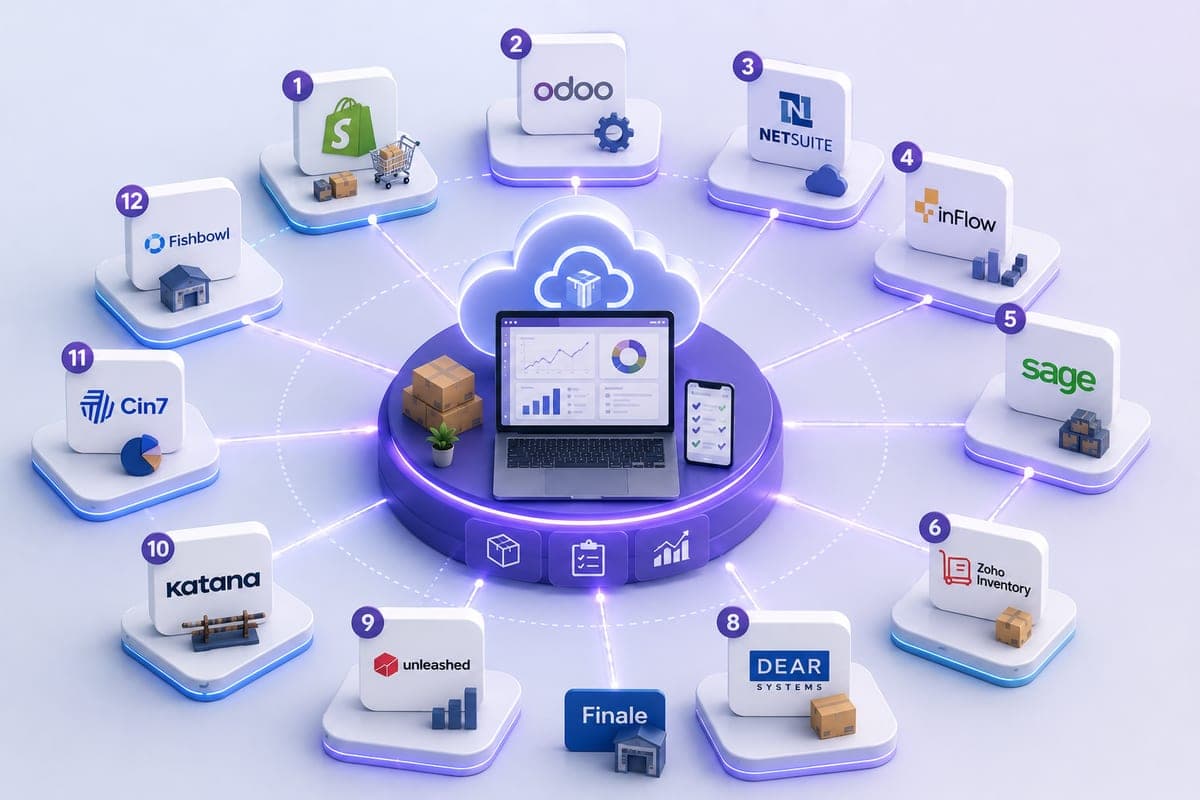
Every "best cloud-based inventory software" list on the internet looks basically the same, Zoho, Cin7, Fishbowl, NetSuite, Linnworks, inFlow, SkuVault, in some order, with the same generic "best for small business" tags. Most of them are written by affiliate sites optimising for commission, not by anyone who has actually run operations on these platforms.
This comparison is different. It is written for ecommerce operators, brands running D2C on Shopify or WooCommerce, selling on Amazon and marketplaces, sometimes dropshipping, sometimes feeding quick commerce, dealing with real supplier relationships and real cancellation rate warnings. It covers what actually differentiates the platforms at scale, what each one is honestly good and bad at, and how to pick the right one for your specific business rather than the one paying the highest affiliate commission.
By the end of this article you will have a clear view of the 12 platforms that matter in 2026, an honest sense of which fits your business, and the evaluation framework to test them properly. No affiliate rankings, no "sponsored placement first" nonsense.
What Cloud-Based Inventory Software Actually Does in 2026
Before the list, a quick alignment on what modern cloud-based inventory software is expected to do. The category has moved well beyond "track stock on a spreadsheet in the cloud." A serious platform in 2026 handles:
- Real-time inventory sync across every sales channel, Shopify, WooCommerce, Amazon, eBay, Walmart, TikTok Shop, Etsy, Meesho
- Multi-warehouse and 3PL management, with intelligent order routing
- Purchase order automation and supplier management
- Native carrier integration for shipping labels and rate-shopping
- Returns workflow from customer initiation to stock re-injection
- Demand forecasting driven by sales velocity and seasonality
- Accounting integration (QuickBooks, Xero, NetSuite, Sage)
- API access for the cases the UI does not cover
- Increasingly, AI features, conversational operations, anomaly detection, dynamic reorder points
Not every platform on this list does all of this, and that is deliberate, different platforms serve different segments. But the framework above is what you should be evaluating against. For the deeper category context, see our cloud-based inventory software guide which walks through the fundamentals in depth.
How This List Is Structured
Rather than ranking 1 to 12, I have grouped the platforms by who they honestly serve best. This is more useful because "the best platform" is genuinely different for a ₹50 lakh/month D2C brand than for a ₹5 crore multichannel operation.
Tier 1: Best for ecommerce and multichannel operators, Nventory, Cin7, Linnworks, Brightpearl, Ordoro
Tier 2: Best for growing small businesses and startups, Zoho Inventory, inFlow, Sortly
Tier 3: Best for manufacturers and hybrid businesses, Fishbowl, MRPeasy, Unleashed
Tier 4: Best for enterprise operations, NetSuite
Within each tier, honest strengths and weaknesses, not just marketing copy.
According to market research summarised by Research.com, the cloud-based inventory management software market grew significantly through 2025 and is projected to keep expanding at 7.7 to 13.1% annually through the mid-2030s, with small and medium enterprises driving most adoption. That growth means more platforms, more choice, and more noise. The list below cuts through it.
Tier 1: Best Cloud-Based Inventory Software for Ecommerce and Multichannel Operators
If you run ecommerce operations across multiple channels, Shopify plus Amazon plus eBay plus TikTok Shop, or similar, these are the platforms actually built for you.
1. Nventory
Best for: Ecommerce brands, multichannel sellers, dropshippers, and Indian operators feeding quick commerce.
What it does well: Real-time bi-directional inventory sync across 30+ channels with sub-5-second latency. Native integrations with Shopify, Amazon, eBay, WooCommerce, TikTok Shop, Walmart, Etsy, Meesho, plus quick commerce platforms like Blinkit, Zepto, and Swiggy Instamart. Intelligent order routing across unlimited warehouses, 3PLs, and Amazon FBA. AI Suite that lets warehouse and operations teams check stock, trigger workflows, and manage orders through WhatsApp, genuinely useful for teams already living in chat apps. Dropshipping module with supplier automation. Native shipping integration with UPS, FedEx, DHL, USPS, plus Delhivery, Shadowfax, Bluedart for Indian operations.
Where it is honestly weaker: Newer entrant vs the 10-year-old platforms on this list, so a smaller partner ecosystem. Best fit for brands scaling in the ₹1 crore to ₹50 crore annual revenue range.
Pricing: Tiered by order volume, not per-SKU or per-channel (which is the healthy pricing model). Free plan available. See pricing details.
Try it: Start free with Nventory
2. Cin7
Best for: Wholesale-and-D2C hybrid brands, multichannel operators wanting deep POS and B2B portal integration.
What it does well: Broad integration coverage (700+ integrations including QuickBooks, Xero, Shopify, Amazon, Walmart, Faire). Built-in POS. Strong B2B wholesale portal. Two product tiers (Core for out-of-the-box, Omni for customisation) covers different sizes of operation.
Where it is honestly weaker: Steeper learning curve than most alternatives, often requires dedicated admin support. Pricing is not transparently published. The two-product structure (Core vs Omni) creates decision friction. Reddit and G2 reviews consistently cite implementation complexity.
Pricing: Custom quote. Typically starts around $349/month for smaller operations, meaningfully higher for Omni.
3. Linnworks
Best for: Multichannel marketplace sellers with high SKU counts.
What it does well: Strong stock forecasting based on historical sales data. Solid Amazon, eBay, and Walmart integration. Robust order fulfillment automation. Customisable reporting.
Where it is honestly weaker: UI feels dated compared to newer entrants. Reports well of steep pricing at higher tiers. Implementation timelines are longer than most operators expect.
Pricing: Custom pricing based on order volume. Historically starts around £150 to £300/month for entry tiers, scales significantly higher.
4. Brightpearl
Best for: Multichannel retailers doing $1M+ in revenue, blending online and physical stores.
What it does well: Strong automation for order routing and inventory. Built for omnichannel retailers, the ecommerce-plus-physical-retail combination. Powerful reporting. Reliable channel integrations.
Where it is honestly weaker: Higher cost. More complex onboarding. Reports of longer time-to-value than lighter alternatives.
Pricing: Custom quote based on business complexity. Typically higher than SMB-focused tools.
5. Ordoro
Best for: Ecommerce teams hitting fulfillment bottlenecks as order volume grows.
What it does well: Focused on fulfillment efficiency. Separate apps for shipping, inventory, and dropshipping, you can adopt only what you need. Multi-channel inventory syncing. Strong shipping automation.
Where it is honestly weaker: Less depth in production or warehouse management. Not the right tool if you need heavy manufacturing or B2B wholesale capabilities alongside ecommerce.
Pricing: Modular pricing, you pay per app you use.
Tier 2: Best Cloud-Based Inventory Software for Small Businesses and Startups
If you are early-stage, under ₹1 crore annual revenue, moving off spreadsheets, or just starting to sell across multiple channels, these are the affordable, easy-to-learn platforms.
6. Zoho Inventory
Best for: Small and midsize retail or distribution teams, especially those already using the Zoho ecosystem.
What it does well: Affordable entry pricing (free tier available with limits, paid plans starting under ₹3,000/month). Deep integration with Zoho Books, Zoho CRM, and the broader Zoho stack. Multi-channel selling support. Reasonable barcode and warehouse tools.
Where it is honestly weaker: Automation and workflow sophistication limits appear as order volume grows. Not the right platform for complex multichannel operations at scale. Reports of some slowness with very large SKU catalogs.
Pricing: Free tier for very small operations. Paid plans from around $59/month.
7. inFlow Inventory
Best for: Small teams and sole entrepreneurs looking for the easiest, cleanest inventory tool.
What it does well: Genuinely intuitive UI, often cited as the easiest inventory tool to onboard. Barcode scanning, purchase orders, sales orders in one clean workflow. Cloud-based with mobile app.
Where it is honestly weaker: Reporting depth is limited compared to enterprise tools. Multichannel capabilities are more basic than Tier 1 platforms. Not built for high-order-volume multichannel operations.
Pricing: Plans from around $89/month. Free 14-day trial.
8. Sortly
Best for: Very small businesses managing physical inventory, tools, or asset tracking.
What it does well: Extremely simple. Strong mobile app with barcode/QR scanning. Photo-based inventory tracking (useful for tools, equipment, and physical assets more than SKU-based ecommerce). Free tier is genuinely usable.
Where it is honestly weaker: Not designed for ecommerce or multichannel selling. Limited channel integrations. Best as an asset-tracking tool, not an operations platform for a selling business.
Pricing: Free tier available. Paid plans from around $29/month.
Tier 3: Best Cloud-Based Inventory Software for Manufacturers and Hybrid Operations
If your operation includes manufacturing, production planning, bill of materials, or complex assembly, these are the platforms built for that.
9. Fishbowl Inventory
Best for: Manufacturers and mid-market businesses deeply integrated with QuickBooks.
What it does well: QuickBooks' #1 inventory integration by adoption, genuinely deep two-way sync. Strong bill of materials, work orders, raw materials tracking, and job costing. Multi-location visibility. Solid reputation in the SMB manufacturing segment. G2 Leader and Capterra Shortlist consistently.
Where it is honestly weaker: Ecommerce and multichannel capabilities are lighter than Tier 1 platforms. The historical desktop legacy still shows in some UI patterns. Two-product structure (Drive vs Advanced) creates decision friction.
Pricing: Fishbowl Drive from $349/month for 2 users. Fishbowl Advanced pricing on request, typically higher.
10. MRPeasy
Best for: Small manufacturers and distributors needing production planning tied to inventory.
What it does well: Genuinely built for manufacturers, tracks purchasing, sales orders, warehouse movements, and production planning as an integrated flow. Easier to onboard than traditional ERP alternatives. Reasonable pricing.
Where it is honestly weaker: Not a fit for pure ecommerce or D2C without manufacturing operations. Limited direct multichannel selling integrations compared to ecommerce-first platforms.
Pricing: Plans from around $49/user/month.
11. Unleashed
Best for: Small businesses managing inventory across multiple locations with light-manufacturing needs.
What it does well: Multi-location visibility. Real-time stock accuracy. Responsive customer support. Good fit for wholesalers and distributors.
Where it is honestly weaker: Less deep on ecommerce multichannel than Tier 1 tools. UI can feel dated. Some users report gaps in specific integrations.
Pricing: Plans from around $349/month for small businesses.
Tier 4: Best Cloud-Based Inventory Software for Enterprise
If your operation is complex enough to justify a full ERP, meaningful revenue, multiple business units, deep financial complexity, NetSuite is the incumbent.
12. NetSuite (Oracle NetSuite ERP)
Best for: Larger enterprises needing a fully integrated ERP covering financials, inventory, order management, and more.
What it does well: True enterprise-grade capability. Deep financials, complex multi-entity support, sophisticated inventory and order management. Owned by Oracle, so long-term platform stability is not a concern. Real-time reporting is genuinely strong.
Where it is honestly weaker: Very high cost. Implementation timelines measured in months or years. Overkill for most SMB and mid-market operations. Steep learning curve. Many capabilities you pay for that a specialised OMS or IMS would cover more cheaply.
Pricing: Custom quotes typically starting well into five figures per year. Implementation costs on top.
How to Actually Choose the Right Platform
Reading feature lists gets you nowhere. Use this evaluation framework instead.
Step 1: Match the platform to your business type
- Pure D2C brand on Shopify with under 3 channels: Zoho Inventory or inFlow to start; Nventory or Cin7 when you scale
- Multichannel ecommerce (D2C + Amazon + eBay + others): Nventory, Cin7, or Linnworks
- Manufacturer or hybrid manufacturing-plus-ecommerce: Fishbowl or MRPeasy
- Retail plus ecommerce hybrid: Brightpearl or Cin7 Omni
- Enterprise: NetSuite
- Indian operator dealing with quick commerce, Meesho, and local carriers: Nventory (built for these specifically)
Step 2: Test with real data, not vendor demos
Vendor demos are choreographed. The real quality of a platform shows up when you:
- Import your actual SKUs (not a clean demo set)
- Connect one live channel
- Simulate a busy day of orders
- Test edge cases, kits, bundles, returns, partial fulfillment
A 14-day trial with your real data reveals more than ten sales demos. Most sync failures, integration gaps, and workflow problems show up in the first two weeks.
Step 3: Check the metrics that actually matter
For any platform you seriously consider, get answers to:
- Sync latency, sub-5 seconds is the modern standard for multichannel
- Native vs middleware integrations, native is stable, middleware breaks at scale
- Multi-warehouse support, unlimited locations should be standard
- Order routing capability, rules-based or basic
- Returns workflow, end-to-end or bolted on
- Uptime SLA, 99.9% is the modern minimum
- API depth, for edge cases the UI does not cover
Step 4: Talk to a customer of similar size
Not a logo on the vendor's website. An actual operator running the platform at similar scale to yours. Ask what has broken, how support responded, and what they wish they had known before signing.
Step 5: Calculate total cost of ownership honestly
Beyond the monthly subscription:
- Implementation costs
- Training time
- Per-integration or per-channel fees
- Per-user seat fees
- Premium support tier costs
- Add-on module costs
A healthy benchmark: total cost of ownership should land between 0.3% and 1% of revenue at scale. Above 2% means you are paying for vendor overhead, not value.
The Most Common Mistakes in Choosing Cloud-Based Inventory Software
Six mistakes I see operators make consistently.
Mistake 1: Choosing based on price alone. The cheapest option often lacks critical features or charges heavily for integrations you will need. Total cost of ownership matters more than the sticker price.
Mistake 2: Choosing based on affiliate-driven reviews. The Retail Exec, SoftwareWorld, and similar sites earn commissions on placements. Their rankings are often skewed toward the highest-commission vendors, not the best fit.
Mistake 3: Not testing integrations in staging. Always test integrations in a sandbox before switching live operations. A broken sync between your inventory and accounting causes real financial discrepancies.
Mistake 4: Underestimating implementation timeline. Vendors sell "up and running in a week." Reality for a multichannel, multi-warehouse operation is 4 to 8 weeks minimum. Plan accordingly.
Mistake 5: Migrating during peak season. Always migrate in your slowest month. Migrating during Diwali or Black Friday is a recipe for chaos.
Mistake 6: Not assigning an internal owner. Without one person owning the platform rollout, decisions stall and the project drags. Assign an owner before you sign anything.
The Trends Actually Shaping This Category in 2026
Beyond the vendor marketing, four shifts are genuinely reshaping cloud-based inventory software this year.
One: AI-driven demand forecasting is moving from premium to standard. Research summarised by Harvard Business Review shows retailers using AI-driven forecasting see 20 to 50% reductions in combined stockouts and overstocks. Platforms that treated this as a paid add-on are now bundling it in.
Two: Conversational operations are real. The shift from "open a dashboard" to "ask via WhatsApp or Slack" is happening in a handful of platforms, and warehouse teams love it because it meets them where they already work. Expect this to become table stakes by 2027.
Three: Quick commerce integration is emerging as a differentiator. Global platforms mostly ignore Blinkit, Zepto, and Instamart. Indian operators feeding these platforms need dedicated integration and forward-warehouse logic. This is where regional platforms have a genuine edge.
Four: Pricing models are consolidating around tiered order volume. Per-SKU pricing punishes catalog growth; per-channel pricing punishes multichannel (which is the whole point); per-order pricing punishes success. Tiered flat-rate by order volume is the model most healthy platforms have converged on. Watch for vendors still using the older punishing models.
For the operational architecture that determines whether any of these platforms actually works at scale, see our supplier management inventory playbook.
Which Cloud-Based Inventory Software Should You Actually Pick?
Honest recommendation summary based on business type:
- Bootstrap / very small: Zoho Inventory (free tier) or inFlow. Move up when you outgrow them.
- Growing D2C brand under ₹5 crore: Nventory or Cin7 Core. Both cover the operational stack; Nventory is stronger on real-time sync and Indian operators, Cin7 is stronger on B2B and wholesale.
- Multichannel ecommerce scaling past ₹5 crore: Nventory, Cin7 Omni, or Linnworks depending on channel mix and geography.
- Retail + ecommerce hybrid: Brightpearl or Cin7 Omni.
- Manufacturer + inventory: Fishbowl or MRPeasy.
- Indian operator with quick commerce, Meesho, and local carrier needs: Nventory (built specifically for this).
- Enterprise with complex financials: NetSuite (probably overkill for most reading this, but the answer for genuine enterprise operations).
Whatever platform you pick, commit to proper implementation, invest in team training, and treat the platform as strategic infrastructure, not a tool to install and forget.
Final Word
The best cloud-based inventory software for your business is the one that fits your specific operational shape, not the one topping affiliate lists or the one advertising loudest. Match the platform to your business type and scale. Trial with real data. Talk to actual operators, not vendor reference logos. Calculate total cost of ownership honestly. Assign an internal owner before you sign anything.
If you are running multichannel ecommerce, dropshipping, or Indian operations with quick commerce integration needs, see how Nventory unifies inventory, orders, and fulfillment across 30+ channels. Browse the full integrations list, or start free with your real data and put your stock and orders on one source of truth.
For the broader inventory software category context, see our cloud-based inventory software guide and supplier management inventory playbook.
Frequently Asked Questions
There is no single 'best', the right platform depends on business type and scale. For multichannel ecommerce operators, Nventory, Cin7, and Linnworks lead the tier. For small businesses starting out, Zoho Inventory and inFlow are strong. For manufacturers, Fishbowl and MRPeasy. For enterprise, NetSuite.
Zoho Inventory offers a free tier for very small operations, with paid plans starting under $60/month. Sortly has a free tier for basic asset tracking. inFlow, MRPeasy, and Nventory all offer entry-tier plans in the $50 to $150/month range. Below that price, the platform is usually not built for real operational scale.
They serve slightly different segments. Cin7 has been in market longer with a larger partner ecosystem and stronger B2B wholesale capability. Nventory has faster real-time sync (sub-5 second), a modern AI Suite with WhatsApp-based conversational operations, and stronger fit for Indian ecommerce operators dealing with quick commerce and local carriers. Test both with your real data; the right answer depends on your specific operational profile.
Entry-tier platforms run ₹3,000 to ₹15,000/month for small operations. Mid-tier for multichannel brands runs ₹15,000 to ₹1,00,000/month. Enterprise platforms with custom contracts run ₹1,00,000+/month. A healthy total cost of ownership is 0.3 to 1% of revenue at scale.
Yes, this is standard for any serious platform in 2026. Nventory, Cin7, Linnworks, Brightpearl, Fishbowl, Zoho Inventory, and Ordoro all offer native integrations with Shopify, Amazon, and most major marketplaces. Verify sync latency (sub-5 seconds is the modern standard) and native-vs-middleware architecture before signing.
Small single-channel operations: 1 to 2 weeks. Multichannel multi-warehouse operations: 4 to 8 weeks. Enterprise ERP implementations (NetSuite): months to over a year. Vendor claims of 'live in one week' for complex operations are usually overselling.
For a single Shopify store under 50 orders/day, Shopify's native tools plus a few apps may suffice. The moment you add a second channel, Amazon, eBay, TikTok Shop, retail, you need a dedicated multichannel platform.
Reputable platforms encrypt data in transit and at rest, are GDPR-compliant, run on infrastructure with 99.9% uptime SLAs, and support role-based access controls. Bigger risk is usually credentials hygiene on your side, enforce two-factor authentication and least-privilege access from day one.
Indian operators face specific needs: GST-compliant invoicing, integration with Blinkit, Zepto, Swiggy Instamart, Meesho, and local carriers (Delhivery, Shadowfax, Bluedart, India Post), plus COD reconciliation. Global platforms handle these unevenly. Nventory is built specifically for these regional operational needs; global platforms like Cin7 and Linnworks handle some but not all.
For most ecommerce brands under $50M revenue, a specialised inventory management system (or unified OMS + IMS) integrating with your accounting software is the right architecture. An ERP is genuinely necessary only when financial complexity outgrows specialised tools.
Yes, and this is increasingly standard. A capable platform treats supplier warehouses as virtual locations alongside your own warehouses, with routing rules for dropship-vs-owned fulfillment. Nventory has a dedicated dropshipping module; Ordoro has a specialised dropshipping app; Cin7 supports it within their broader platform.
Reputable platforms have redundancy, queueing, and offline modes. Orders queue on the channel side and sync once the platform is available. Any platform without a published 99.9% uptime SLA is a risk you should not accept in 2026.
Related Articles
View all
PO Systems for Small Business: What They Do and How to Choose One
How purchase order systems work, when a small business actually needs one, the four types available, and a checklist for choosing between them.

Best Inventory Management Software in India in 2026: Matched by Business Model
Best inventory management software in India, matched by business model, honest pricing, and what top Indian ecommerce operators actually run in 2026.